Santa Maria del Giglio Church
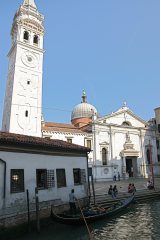
Church near Campo Santa Maria del Giglio, notable for its baroque façade and its works of art.
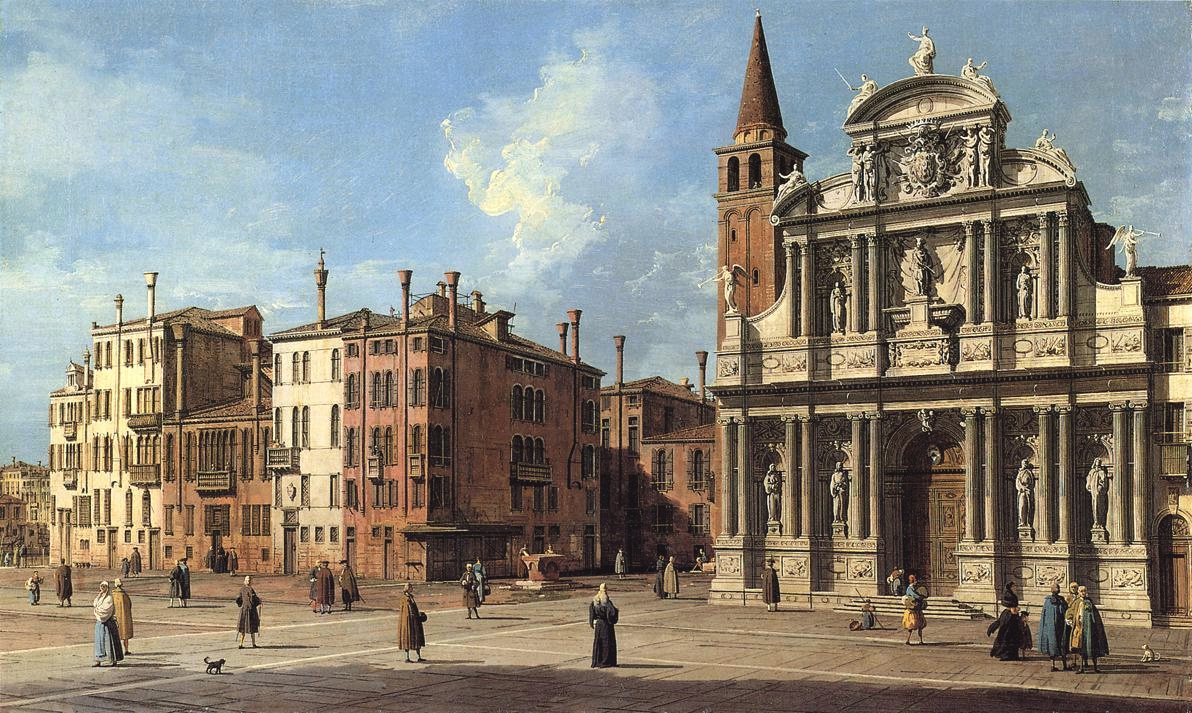
Santa Maria del Giglio, a baroque façade-manifesto
The church of Santa Maria del Giglio stands on a small, elegant campo in the San Marco district, just steps from the Grand Canal, the La Fenice theatre and Campo Santo Stefano. Also known by its older name, Santa Maria Zobenigo, it has medieval origins but owes its present appearance to an almost complete rebuilding carried out in the second half of the 17th century.
The earlier church, rebuilt several times after fires, had become unstable by the mid-17th century. The new building was completed around 1680 under the direction of Giuseppe Benoni. But it is above all its façade, designed by the architect Giuseppe Sardi, that gives it its exceptional character: few Venetian churches display the ambitions and memory of a patrician family quite so openly.
A religious façade almost entirely devoted to the Barbaro family
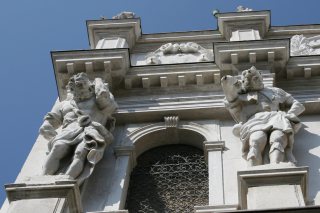
The scheme was commissioned by Antonio Barbaro, a prominent soldier and diplomat of the Republic, who set aside the considerable sum of 30,000 ducats in his will for its execution. Rather than covering the façade with saints or biblical scenes, its decoration celebrates his career and that of his brothers: life-size statues, civic and military virtues, trophies and depictions of the territories where Antonio had served make up most of the composition.
At the centre stands Antonio Barbaro himself, surrounded by the effigies of his four brothers. The two levels of paired columns, Ionic below and Corinthian above, impose a very strict order on this abundance of sculpture. In stone, the façade thus becomes a true Barbaro family monument, almost more devoted to service to the Republic and to family glory than to the church's religious programme.
This display says a great deal about 17th-century Venetian society. In a Republic that officially distrusted personal glorification, great families found in churches, chapels and funerary monuments particularly effective ways of inscribing their prestige within the city. At Santa Maria del Giglio, this approach reaches a scale rarely matched elsewhere: worshippers must almost walk through the Barbaro family's history before entering the church.
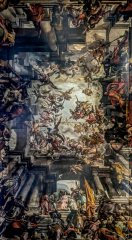
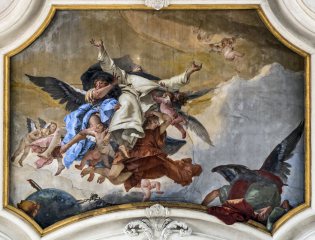
The interior, more restrained than the façade, follows a single nave lined with chapels. Its ceiling is decorated with large paintings by Antonio Zanchi, while several generations of Venetian artists are represented in the chapels and on the altars, including works by Sebastiano Ricci, Giambattista Piazzetta, Palma the Younger, Alessandro Vittoria and Gian Maria Morlaiter, along with an interesting set of Stations of the Cross painted in the 18th century by several artists.
Tintoretto is also present, with the Four Evangelists, painted in 1557 for the shutters of the former organ and now kept behind the high altar. Their presence is a reminder that, behind the exuberance of its baroque façade, Santa Maria del Giglio also holds an artistic ensemble spanning several centuries of Venetian painting and sculpture.
The visit can be fairly brief, but it is well worth taking the time to read the façade from bottom to top. Its maps, figures and allegories are not mere decoration: together they form a carefully considered political and family programme. Just minutes from La Fenice, Santo Stefano and the Grand Canal, Santa Maria del Giglio offers one of the most striking examples of how Venetian baroque could turn a church façade into a manifesto of prestige.
Sources and further information
Chorus Venezia - Santa Maria del Giglio; UNESCO - restoration of the Santa Maria del Giglio façade; Save Venice - Santa Maria del Giglio.
Map and route
Near Santa Maria del Giglio and places in the district
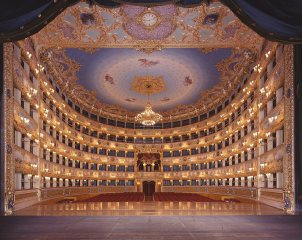 Theatre
La Fenice Theatre
150 m
Theatre
La Fenice Theatre
150 m
 Square
Campo and church of Santo Stefano
210 m
Square
Campo and church of Santo Stefano
210 m
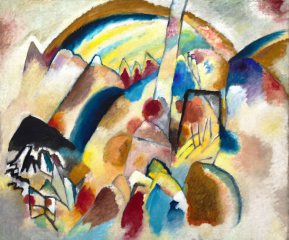 Museum
Peggy Guggenheim Collection
219 m
Museum
Peggy Guggenheim Collection
219 m
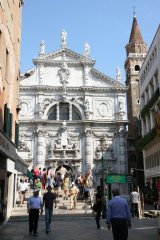 Church
 of San Moisè
252 m
Church
Church of San Moisè
252 m
In the San Marco sestiere
Nearby places to stay
Sur le même thème