Facing the Zattere, Giudecca offers a quieter, more open and noticeably less crowded Venice. One comes here for the church of the Redentore, the views over Saint Mark’s Basin, the old industrial buildings and the long walks along the water. The island retains a true neighborhood life, away from the main tourist routes. It is also one of the best places to observe Venice as a whole rather than monument by monument.
Giudecca, Venice seen from the other shore
Stretching south of the historic center, Giudecca faces the Zattere, from which it is separated by the wide canal of the same name. It does not form a single island but a string of islets connected by bridges, administratively attached to the Dorsoduro sestiere.
Long called Spinalonga, probably because of its elongated shape, it took its current name in the Middle Ages. Its origin remains debated, and the old hypotheses directly associating it with a Jewish presence are not established with certainty.
During the Renaissance, Giudecca was still largely occupied by gardens, orchards, convents and holiday residences belonging to Venetian families. Its northern front already offered a vast panorama over the city, while its southern shore opened onto the lagoon.
From the 19th century onward, the island underwent a major industrial transformation. Factories, shipyards, workshops and workers’ housing were set up alongside the old convents. This history explains its current landscape, where religious architecture rubs shoulders with former industrial buildings that have been converted. The former Junghans factories have been transformed into housing and cultural spaces. Alongside the still-visible workshops and shipyards, they bear witness to the strong working-class identity that marked the island in the 19th and 20th centuries.
The main places to discover
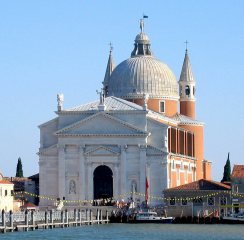
- The church of the Redentore is the main monument of Giudecca. Built to the plans of Andrea Palladio from 1577, it was raised in thanks for the end of the terrible plague epidemic of 1575-1577. Its white façade, designed to be admired from Venice, dominates the canal with monumental sobriety.
- The Molino Stucky is the former large industrial mill built at the end of the 19th century by the entrepreneur Giovanni Stucky. Its brick mass, inspired by Northern European Neo-Gothic architecture, recalls the era when Giudecca was one of the main industrial hubs of Venice.
- The church of the Zitelle, officially Santa Maria della Presentazione, belonged to an institution founded to welcome and train poor young girls at risk of prostitution. Built at the end of the 16th century, it is part of the great architectural landscape designed around the Saint Mark’s Basin.
- The garden of the Redentore convent forms behind the church a vast green oasis, with orchard, vegetable garden, medicinal plants and views over the southern lagoon. Long closed to the public, it can now be visited at certain times.
- The church of Sant’Eufemia is one of the oldest buildings on the island. Remodeled several times, it notably retains a Gothic portico from the former church of Santi Biagio e Cataldo.
- The Casa dei Tre Oci, recognizable by its three large windows overlooking the canal, was built at the beginning of the 20th century by the painter Mario De Maria. Its architecture blends Venetian references with a modern sensibility.
- The former complex of Santi Cosma e Damiano preserves around its vast cloister the old church and part of the convent founded during the Renaissance. Today it houses artists’ studios, craft activities and cultural spaces.
The Feast of the Redentore, celebrated every year in July, recalls this ancient vow. A floating bridge then temporarily connects the Zattere to Giudecca, while processions, decorated boats and fireworks enliven the entire Saint Mark’s Basin.
Walking along the fondamenta finally offers one of the most beautiful panoramic views over the Zattere, the Salute and the Saint Mark’s Basin. More residential and less monumental than the heart of Venice, Giudecca above all allows you to look at the city from a distance — which, in the case of Venice, sometimes helps to better understand it.
Places in Giudecca
7 places in this district.
 1
Church
Church of the Redeemer
Palladio's masterpiece, built as a vow against the plague, overlooking the Giudecca Canal with its white facade.
1
Church
Church of the Redeemer
Palladio's masterpiece, built as a vow against the plague, overlooking the Giudecca Canal with its white facade.
 2
Monument
Molino Stucky
Former 19th-century neo-Gothic industrial mill, now converted into a hotel and conference center.
3
Church
Church of the Zitelle
Church and former shelter for poor young girls, whose architecture was long attributed to Palladio.
4
Garden
Kitchen Garden of the Redentore Convent
Vast convent garden behind the Redentore church, with kitchen garden, vineyard and views over the southern lagoon.
5
Church
Church of Sant'Eufemia
One of the oldest religious buildings in Venice, with a Gothic portico and origins dating back to the 9th century.
6
Museum
Casa dei Tre Oci
An early 20th-century artist's house recognizable by its three large windows, now a center for photographic exhibitions.
7
Church
Saints Cosmas and Damian Complex
Former Benedictine convent and deconsecrated church on the Giudecca, later a hosiery factory and then an incubator for artisan wor…
2
Monument
Molino Stucky
Former 19th-century neo-Gothic industrial mill, now converted into a hotel and conference center.
3
Church
Church of the Zitelle
Church and former shelter for poor young girls, whose architecture was long attributed to Palladio.
4
Garden
Kitchen Garden of the Redentore Convent
Vast convent garden behind the Redentore church, with kitchen garden, vineyard and views over the southern lagoon.
5
Church
Church of Sant'Eufemia
One of the oldest religious buildings in Venice, with a Gothic portico and origins dating back to the 9th century.
6
Museum
Casa dei Tre Oci
An early 20th-century artist's house recognizable by its three large windows, now a center for photographic exhibitions.
7
Church
Saints Cosmas and Damian Complex
Former Benedictine convent and deconsecrated church on the Giudecca, later a hosiery factory and then an incubator for artisan wor…