San Polo brings together several faces of Venice: the great commercial center of Rialto, an exceptional religious and artistic heritage around the Frari, but also a maze of alleys, canals, and more discreet small squares. Very busy near the Grand Canal, the neighborhood quickly regains a more peaceful atmosphere as soon as one moves away from the main thoroughfares.
San Polo, the commercial heart of Venice
Located in the center of Venice, on the right bank of the Grand Canal, San Polo is the smallest of the six sestieri. Its modest size has never prevented it from playing an essential role in the history of the city: it is home to Rialto, one of the oldest inhabited cores of Venice and, for centuries, its main economic center.
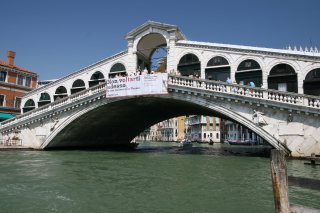
The Rialto Bridge, completed at the end of the 16th century, today marks the most famous entrance to the sestiere. Its stone arch lined with shops replaced several wooden bridges, regularly damaged, burned, or victims of their own success. It connects San Polo to San Marco by crossing the Grand Canal at one of its liveliest points.
A few steps away, the Rialto markets perpetuate a tradition of nearly a thousand years. The Pescheria, housed under its neo-Gothic loggias, remains dedicated to fish and seafood, while the neighboring stalls offer fruit and vegetables. Despite tourist crowds, the area still retains a real commercial function.
Moving away from Rialto, San Polo quickly changes its face. The narrow passages open onto small campi, ancient wells, discreet palaces, and churches often less visited. The district is crossed by very lively itineraries, but a few detours suffice to find a more silent Venice.
Main places to discover
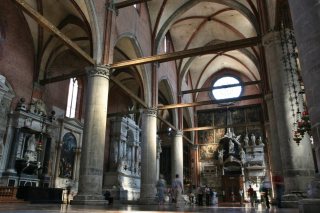
- The basilica of Santa Maria Gloriosa dei Frari: an immense Gothic Franciscan church, it is one of the great religious and artistic complexes of Venice. It notably houses Titian's Assumption of the Virgin and the Pala Pesaro, the Frari triptych by Giovanni Bellini, a sculpture by Donatello, as well as several monumental tombs.
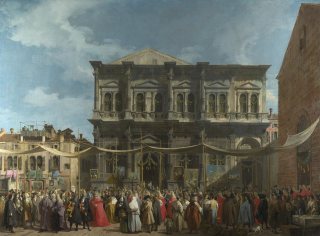
- The Scuola Grande di San Rocco: seat of one of the main Venetian confraternities, it preserves an extraordinary collection of paintings by Tintoretto created over more than twenty years. Its richly decorated large halls make it one of the major artistic monuments of Venice.
- The Rialto Bridge: built in stone between 1588 and 1591, it is the oldest of the four current bridges crossing the Grand Canal. Lined with shops and designed as a true piece of city above the water, it is one of the most emblematic architectural works of Venice.
- The market and the old commercial district of the Rialto: around the Pescheria and the Erberia remains the heart of the old commercial center of the Republic. Markets, old craft streets, commercial buildings, and reminders of financial institutions recall the essential role played for centuries by Rialto in the Venetian economy.
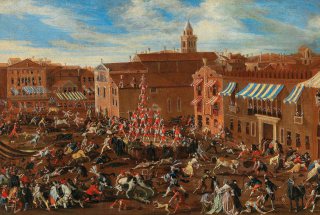
- Campo San Polo: the largest campo in Venice, it was for centuries a place for markets, festivals, shows, ceremonies, and public games. Even today, its vast dimensions and the palaces that surround it make it one of the most interesting urban spaces in the sestiere.
- The Scuola Grande di San Giovanni Evangelista: founded in the 13th century, it forms a remarkable ensemble combining Gothic, Renaissance, and Baroque architecture. Its monumental courtyard, marble portal, and large halls bear witness to the wealth and prestige acquired by the confraternity.
- The church of San Giacomo di Rialto: often called San Giacometo, this small church is intimately linked to the history of the Rialto commercial district. Its portico and its large clock make it one of the most characteristic landmarks of the area, even if the tradition that dates its foundation to 421 is not historically proven.
- The church of San Polo: transformed several times over the centuries, this ancient church preserves a curious mixture of medieval and later elements. It notably houses works by Tintoretto, Palma il Giovane, and Giandomenico Tiepolo, as well as a remarkable Gothic portal decorated with lions.
- The Casa di Carlo Goldoni: housed in the Palazzo Centanni, a Gothic palace where Carlo Goldoni was born in 1707, it is dedicated to the great Venetian playwright and the history of theater. The rooms evoke his world through paintings, furniture, documents, and small puppet theaters.
- Campo San Tomà and the Scoletta dei Calegheri: a small square located between the Grand Canal and the Frari, it preserves, opposite the church of San Tomà, the ancient school of the shoemakers' guild, with a relief attributed to Pietro Lombardo. The area also has the San Tomà traghetto, which maintains a traditional gondola link with the other bank of the Grand Canal.
- The church of San Rocco: immediate neighbor of the Scuola Grande, it was built for the confraternity that preserved the relics of Saint Roch, invoked against the plague. Several works by Tintoretto still decorate its interior and naturally complete the visit to the Scuola.
- The Carampane and the Ponte delle Tette: a few steps from Rialto, this network of alleys corresponds to one of the areas historically associated with regulated prostitution in Venice. The small Ponte delle Tette preserves the memory of it in its name.
Other remarkable places
- The Riva del Vin: this quay on the Grand Canal extends from the Rialto area toward San Silvestro. Its name recalls that, from the Middle Ages, boats loaded with wine docked there and that the Republic controlled the trade and quality of wine; it is both a beautiful viewpoint over the Grand Canal and a very legible vestige of the commercial Rialto.
- The church of San Giovanni Elemosinario: discreetly integrated into the very dense fabric of the Rialto, it was rebuilt in the 16th century after the great fire of 1514. It notably preserves works by Titian and Pordenone and constitutes an interesting complementary stop in the discovery of the commercial district.
- Campo Sant'Aponal constitutes a pleasant transition between San Polo and the Rialto, with the ancient church of Sant'Aponal. The Comune also integrates it into its commercial Rialto itinerary.
Places in San Polo
15 places in this district.
 1
Church
Santa Maria Gloriosa dei Frari
Large Franciscan basilica in San Polo, important for Gothic architecture and Venetian painting.
1
Church
Santa Maria Gloriosa dei Frari
Large Franciscan basilica in San Polo, important for Gothic architecture and Venetian painting.
 2
Museum
Scuola Grande di San Rocco
Seat of a great Venetian confraternity, famous for the vast cycle painted by Tintoretto.
2
Museum
Scuola Grande di San Rocco
Seat of a great Venetian confraternity, famous for the vast cycle painted by Tintoretto.
 3
Bridge
Rialto Bridge
The most famous bridge in Venice connects San Polo to San Marco over the Grand Canal, in the historic heart of Rialto's trade.
3
Bridge
Rialto Bridge
The most famous bridge in Venice connects San Polo to San Marco over the Grand Canal, in the historic heart of Rialto's trade.
 4
Market
Rialto Market
Historic market in Venice, around the Pescheria and the Erberia, in the heart of the Rialto district.
4
Market
Rialto Market
Historic market in Venice, around the Pescheria and the Erberia, in the heart of the Rialto district.
 5
Square
Campo San Polo
A large and popular square in San Polo, long used for festivals, markets and neighborhood gatherings.
5
Square
Campo San Polo
A large and popular square in San Polo, long used for festivals, markets and neighborhood gatherings.
 6
Monument
Scuola Grande San Giovanni Evangelista
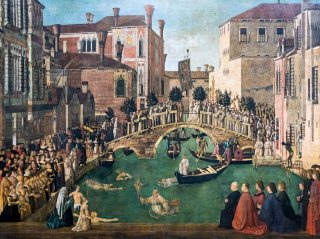
Ancient great confraternity of San Polo, known for its portal, monumental halls, and history linked to a relic of the Cross.
6
Monument
Scuola Grande San Giovanni Evangelista
Ancient great confraternity of San Polo, known for its portal, monumental halls, and history linked to a relic of the Cross.
 7
Church
Church of San Giacomo di Rialto
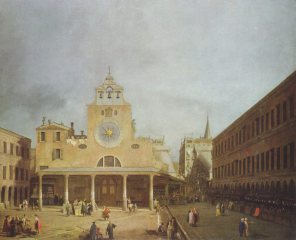
Nicknamed San Giacometo, this small church in the Rialto market claims to be the oldest church in Venice and features a 24-hour cl…
8
Church
Church of San Polo
Church on the Campo San Polo, transformed over the centuries and rich in Venetian works of art, close to the Basilica of the Frari…
9
Museum
House of Carlo Goldoni
House-museum dedicated to Carlo Goldoni, Venetian comedy, and 18th-century theater.
10
Square
Campo San Tomà and Scoletta dei Calegheri
Small campo near the Frari, overlooked by the former Gothic seat of the Venetian shoemakers' guild, now a neighborhood library.
7
Church
Church of San Giacomo di Rialto
Nicknamed San Giacometo, this small church in the Rialto market claims to be the oldest church in Venice and features a 24-hour cl…
8
Church
Church of San Polo
Church on the Campo San Polo, transformed over the centuries and rich in Venetian works of art, close to the Basilica of the Frari…
9
Museum
House of Carlo Goldoni
House-museum dedicated to Carlo Goldoni, Venetian comedy, and 18th-century theater.
10
Square
Campo San Tomà and Scoletta dei Calegheri
Small campo near the Frari, overlooked by the former Gothic seat of the Venetian shoemakers' guild, now a neighborhood library.
 11
Church
San Rocco Church
Church built by the Scuola Grande di San Rocco, next to the Basilica of the Frari, housing several large canvases by Tintoretto de…
12
Bridge
Ponte delle Tette
Small bridge in the historic Carampane district, whose name recalls the former area reserved for prostitution under the Republic o…
13
Street / Area
Riva del Vin
An open quay on the Grand Canal at the foot of the Rialto Bridge, formerly a wine unloading spot, now lined with terraces overlook…
11
Church
San Rocco Church
Church built by the Scuola Grande di San Rocco, next to the Basilica of the Frari, housing several large canvases by Tintoretto de…
12
Bridge
Ponte delle Tette
Small bridge in the historic Carampane district, whose name recalls the former area reserved for prostitution under the Republic o…
13
Street / Area
Riva del Vin
An open quay on the Grand Canal at the foot of the Rialto Bridge, formerly a wine unloading spot, now lined with terraces overlook…
 14
Church
San Giovanni Elemosinario Church
Renaissance church enclosed within the Rialto market, rebuilt by Scarpagnino after the fire of 1514, with altarpieces by Titian an…
15
Square
Campo Sant'Aponal
Small campo in the Rialto, dominated by a deconsecrated Gothic church, closed to worship and turned into a warehouse after several…
14
Church
San Giovanni Elemosinario Church
Renaissance church enclosed within the Rialto market, rebuilt by Scarpagnino after the fire of 1514, with altarpieces by Titian an…
15
Square
Campo Sant'Aponal
Small campo in the Rialto, dominated by a deconsecrated Gothic church, closed to worship and turned into a warehouse after several…