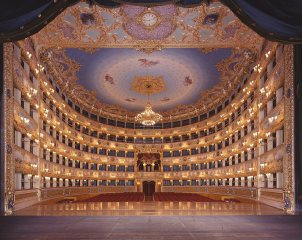
Scuola Grande di San Rocco Museum
Seat of a great Venetian confraternity, famous for the vast cycle painted by Tintoretto.
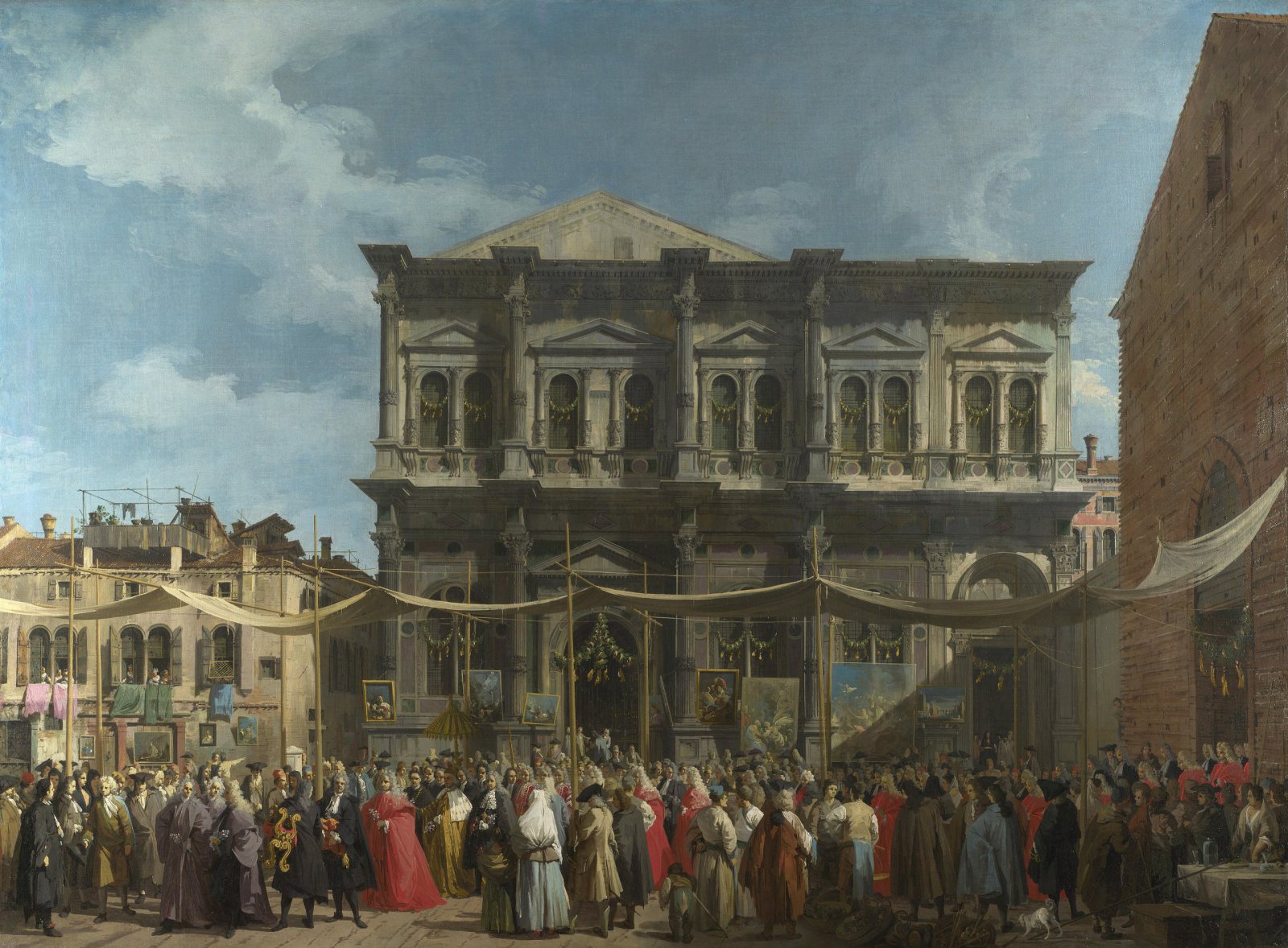
Scuola Grande di San Rocco, the great cycle by Tintoretto
The Scuola Grande di San Rocco stands on Campo San Rocco, a few steps from the Basilica of the Frari. Behind its monumental facade is one of the most remarkable artistic ensembles in Venice: more than sixty paintings are still preserved in the spaces for which they were designed, dominated by the vast cycle created by Tintoretto over more than twenty years.
The place was not a palace but the seat of a religious and charitable confraternity. Founded in 1478 and placed under the protection of Saint Roch, invoked against the plague, it enjoyed rapid prosperity thanks to the strong popular devotion to the saint, from whom it obtained relics in 1485.
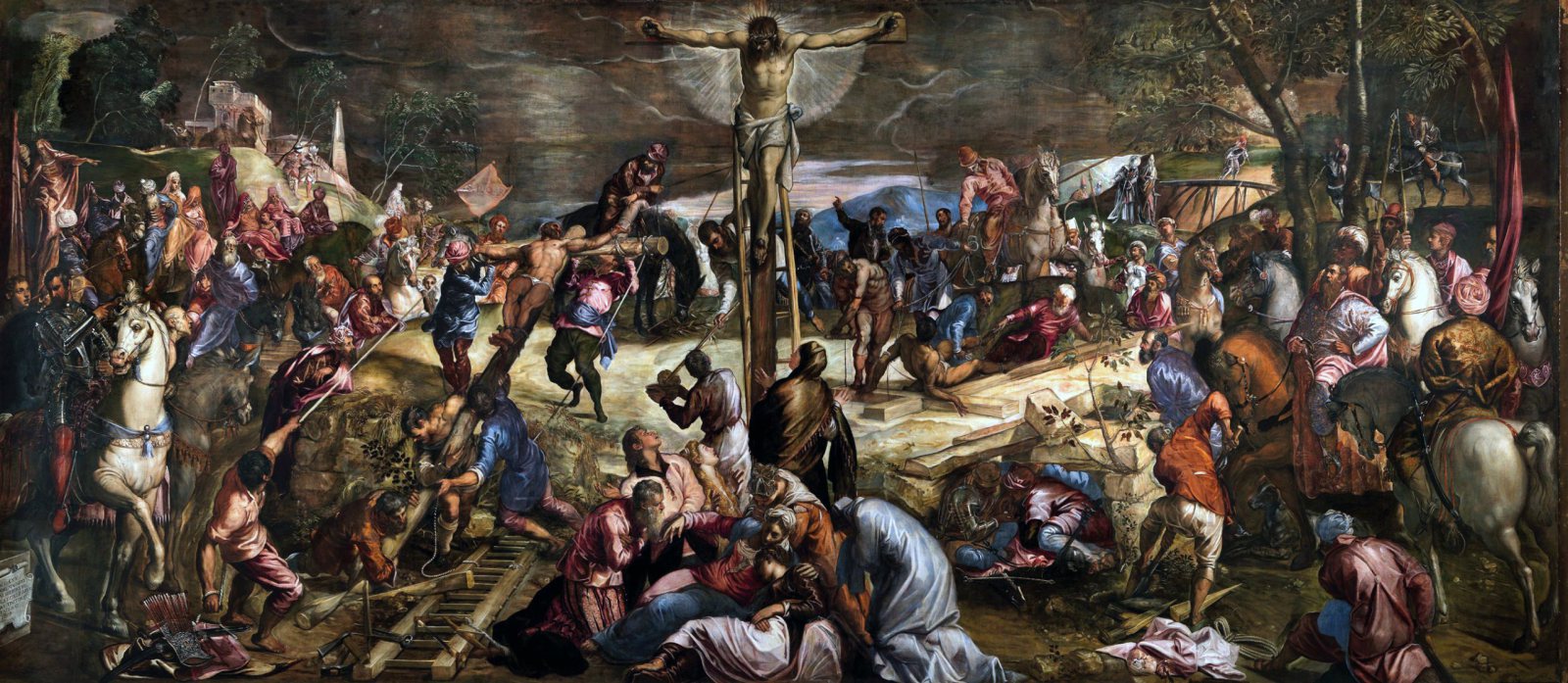
Crucifixion (Jacopo Tintoretto, 1565)

A great confraternity of 16th-century Venice
Construction of the new Scuola Grande began in 1517. Several architects followed one another on the site, notably Pietro Bon, Sante Lombardo, and then Antonio Abbondi, known as Scarpagnino, to whom the building owes much of its present appearance. He notably completed the facade overlooking the campo and designed the majestic multi-flight staircase that connects the two main levels.
The interior layout corresponds to the confraternity’s functions. On the ground floor, the vast Sala Terrena is divided by two rows of columns. Upstairs, the large Sala Capitolare hosted the assemblies of the members, while the smaller Sala dell’Albergo was reserved for the governing bodies. Architecture, painting and furnishings thus formed a whole intended both for religious life and for demonstrating the prestige of the institution.
Tintoretto and an exceptional commission
The story of Tintoretto at San Rocco begins in 1564, when the confraternity organized a competition to decorate the ceiling of the Sala dell’Albergo. According to the account handed down by Giorgio Vasari, while the other artists were required to present drawings, Tintoretto had his Saint Roch in Glory installed directly in the intended spot. Faced with protests, he offered to give the work to the confraternity for free, which finally accepted.
Having become a member of San Rocco in 1565, Tintoretto that same year painted the immense Crucifixion in the Sala dell’Albergo, one of his most spectacular compositions. He completed the decoration of this room in 1567, choosing mainly episodes from the Passion of Christ rather than scenes from the life of Saint Roch.
He then continued his work in the Sala Capitolare. Between 1575 and 1581, the ceiling and walls were covered with a vast program combining the Old and New Testaments: the Brazen Serpent, Moses Striking the Rock or the Manna dialogue with the Baptism of Christ, the Resurrection, the Last Supper or even the Multiplication of the Loaves. The room alone brings together thirty-three paintings in a program conceived as a coherent whole.
Finally, from 1582, Tintoretto undertook the large paintings in the Sala Terrena, devoted mainly to the life of the Virgin and the childhood of Christ. The Annunciation, the Adoration of the Magi, the Flight into Egypt or the dramatic Massacre of the Innocents allow us to follow the evolution of his painting until the completion of this last part of the cycle in 1587.
Visiting the Scuola Grande di San Rocco
The main interest of the visit lies in the preservation of the paintings in their original setting. They have not been artificially assembled in a museum: the perspectives, the lighting, the carved ceilings and the dimensions of the canvases were designed for these rooms. The spectacular foreshortenings, the contrasts between shadow and light and the compositions often seen from below thus take on their full meaning.
The tour is not limited to Tintoretto, moreover. The monumental staircase notably preserves large 17th-century compositions dedicated to plague epidemics, by Antonio Zanchi and Pietro Negri. The Sala Capitolare also has a remarkable set of woodwork and allegorical sculptures by Francesco Pianta, while the collections include works by Giorgione, Titian and Tiepolo, as well as a treasure of fabrics and precious objects.
The Scuola thus offers much more than a succession of paintings: it enables us to understand how a great Venetian confraternity functioned and how charity, religion, social prestige and artistic patronage were intertwined in Renaissance Venice. Remarkably, the confraternity still exists today and has preserved its buildings despite the Napoleonic suppressions of the early 19th century.
Its proximity to the Frari and the church of San Rocco finally makes it possible to combine in a single itinerary several of the great artistic and religious testimonies of San Polo.
Sources and further information
Scuola Grande di San Rocco - official website ; Scuola Grande di San Rocco - Sala dell’Albergo ; Scuola Grande di San Rocco - Sala Capitolare ; Scuola Grande di San Rocco - Sala Terrena.
Map and route
Near the Scuola Grande di San Rocco and places in the district
 Church
San Rocco Church
42 m
Church
San Rocco Church
42 m
 Church
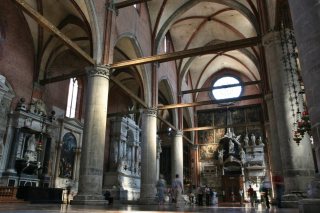
Santa Maria Gloriosa dei Frari
100 m
Church
Santa Maria Gloriosa dei Frari
100 m
 Church
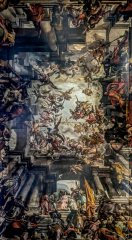
San Pantalon Church
112 m
Square
Campo San Tomà and Scoletta dei Calegheri
169 m
Church
San Pantalon Church
112 m
Square
Campo San Tomà and Scoletta dei Calegheri
169 m
In the San Polo sestiere

Nearby places to stay
Sur le même thème