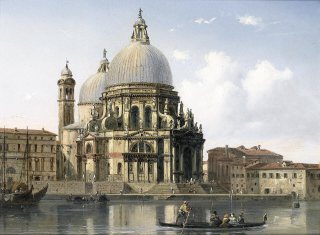
Santa Maria Gloriosa dei Frari Church
Large Franciscan basilica in San Polo, important for Gothic architecture and Venetian painting.
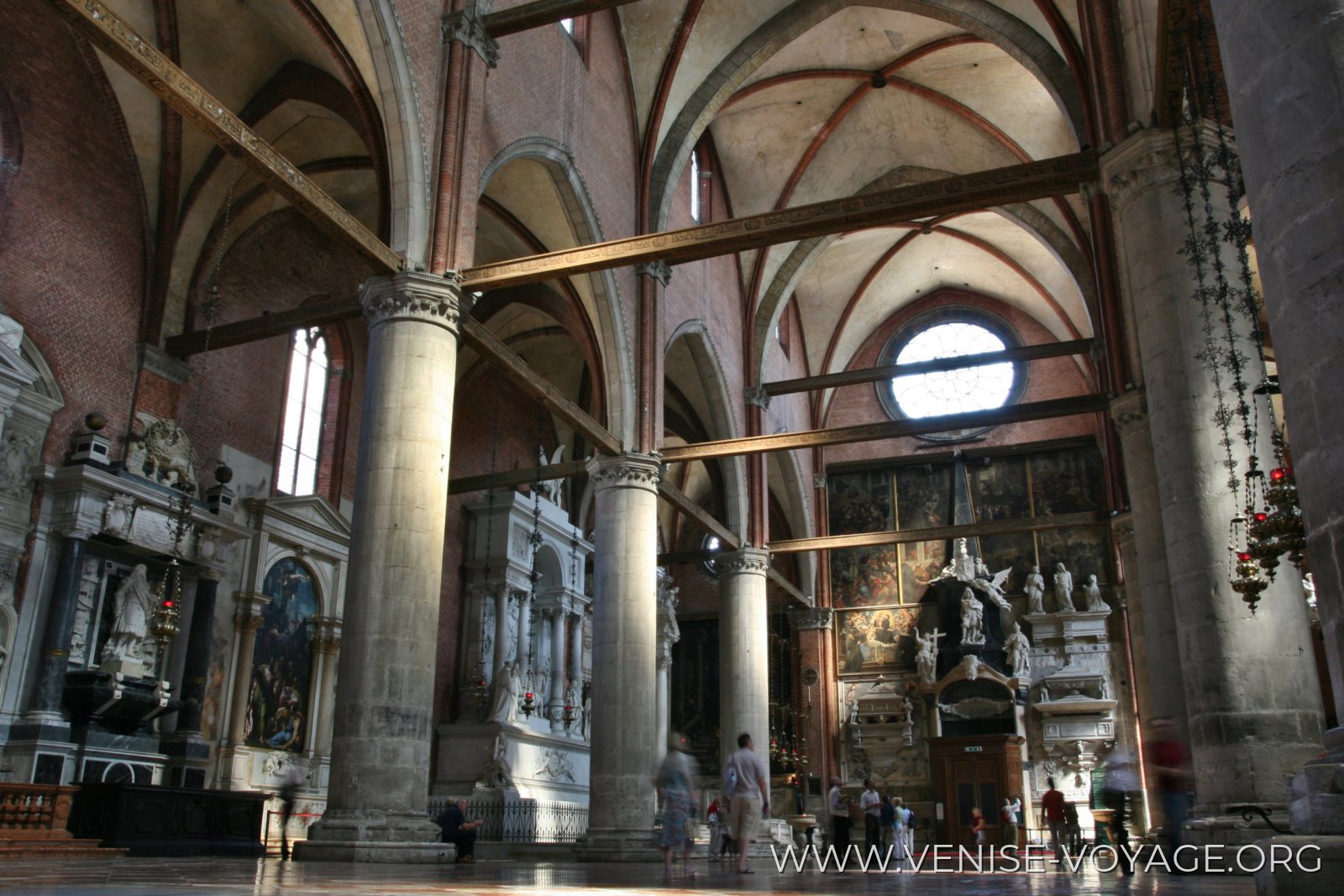
Frari, great Franciscan basilica of Venice
Santa Maria Gloriosa dei Frari dominates the west of San Polo with its vast brick mass, austere facade and tall campanile. With Santi Giovanni e Paolo, it is among the great monuments of Venetian religious Gothic. But the Frari is also one of the essential places to discover Venetian painting and sculpture, as the works have here preserved an exceptional link with the architecture for which they were created.
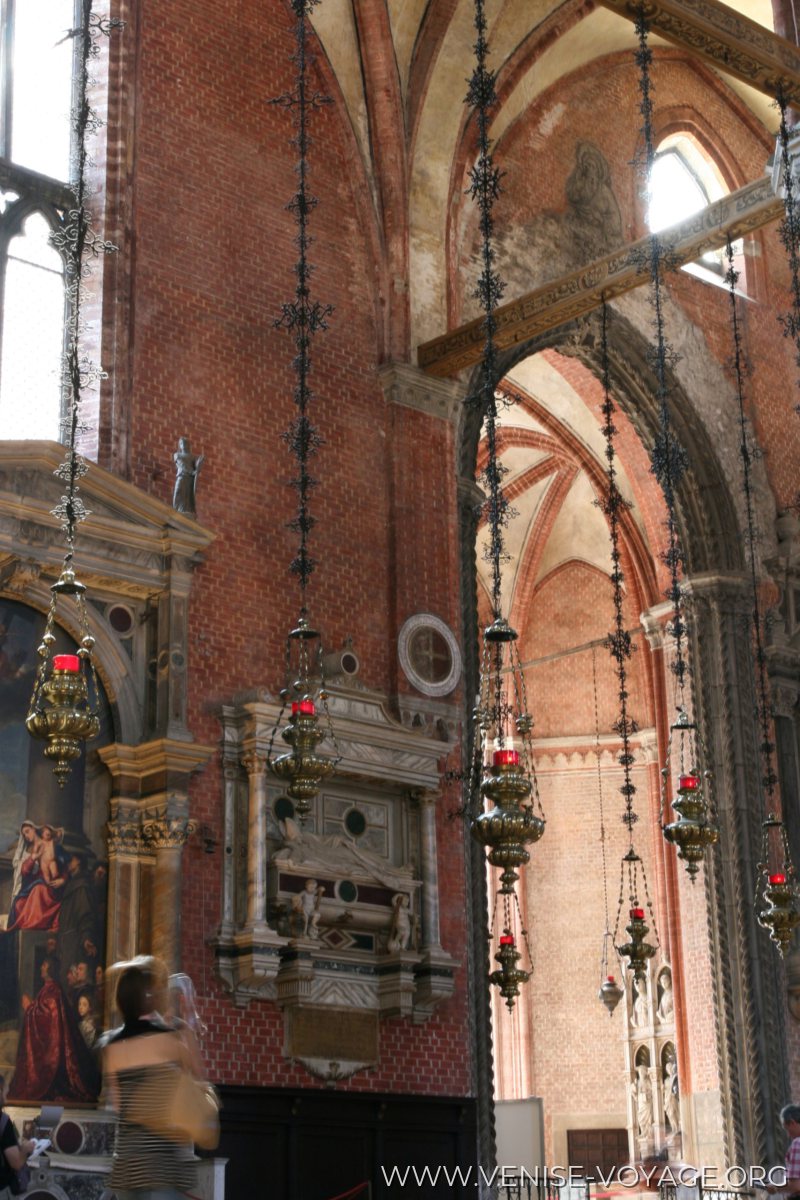
Nave of the Frari
The Franciscan Friars Minor arrived in Venice shortly after 1220 and received around 1231 land still partly marshy to build a first church and a convent. Having quickly become too small, it was replaced from 1250. Around 1330 the construction of a third, much larger building began: the current basilica, consecrated in 1492.
Its architecture remains faithful to a Franciscan ideal of simplicity. The basilica, about 102 meters long, has a Latin cross plan with three naves, a transept and chapels around the sanctuary. Brick dominates, while white Istrian stone highlights the openings and certain architectural elements. The facade was completed in the 15th century and the campanile, finished in 1396, further emphasizes the monumental silhouette of the whole.
From Titian to Bellini, an exceptional journey
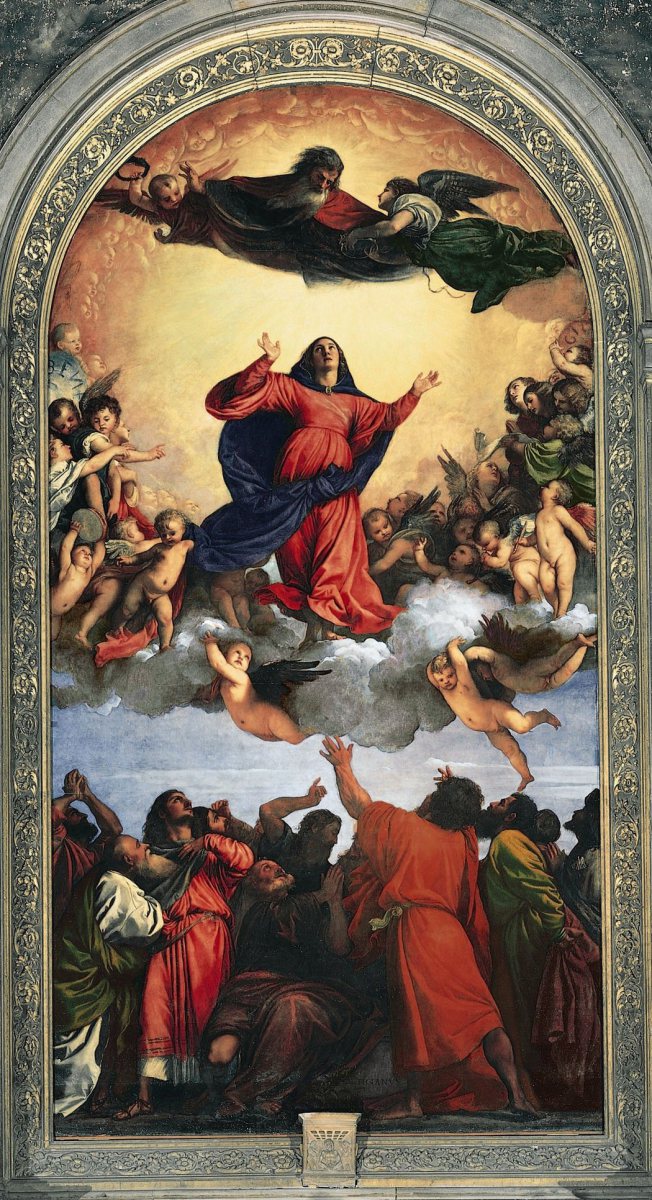
The Assumption of the Virgin (Titian, 1516-18, via Wikimedia Commons)

Inside, the eye is naturally drawn to the high altar by Titian's Assumption of the Virgin, painted between 1516 and 1518. The monumental composition, designed specifically for this location, accompanies the elevation of the architecture: the apostles occupy the lower part, the Virgin rises in a circle of light and God the Father dominates the scene. The distance from the nave and the framing of the choir fully contribute to the intended effect.
Titian is also the author of the Madonna di Ca' Pesaro, painted between 1519 and 1526. Placed in the left nave, it breaks with the traditional frontal composition by placing the Virgin on an oblique axis, above the members of the Pesaro family. This arrangement almost transforms the altar and the painting into a single mise-en-scène.
Other masterpieces alone would justify the visit. In the sacristy, Giovanni Bellini's Frari Triptych, dated 1488, associates the Virgin and Child with several saints in a painted architecture that visually extends its setting. The basilica also houses the Saint John the Baptist sculpted by Donatello in 1438, as well as works by Bartolomeo Vivarini, Alvise Vivarini, Paolo Veneziano and Alessandro Vittoria.
In the center of the church remains the remarkable monks' choir, whose wooden stalls were made in 1468 by Marco and Francesco Cozzi. Its monumental marble enclosure is a particularly rare survival in Venice: far from being simple furniture, it structures the perspective of the nave and organizes the transition to the sanctuary.
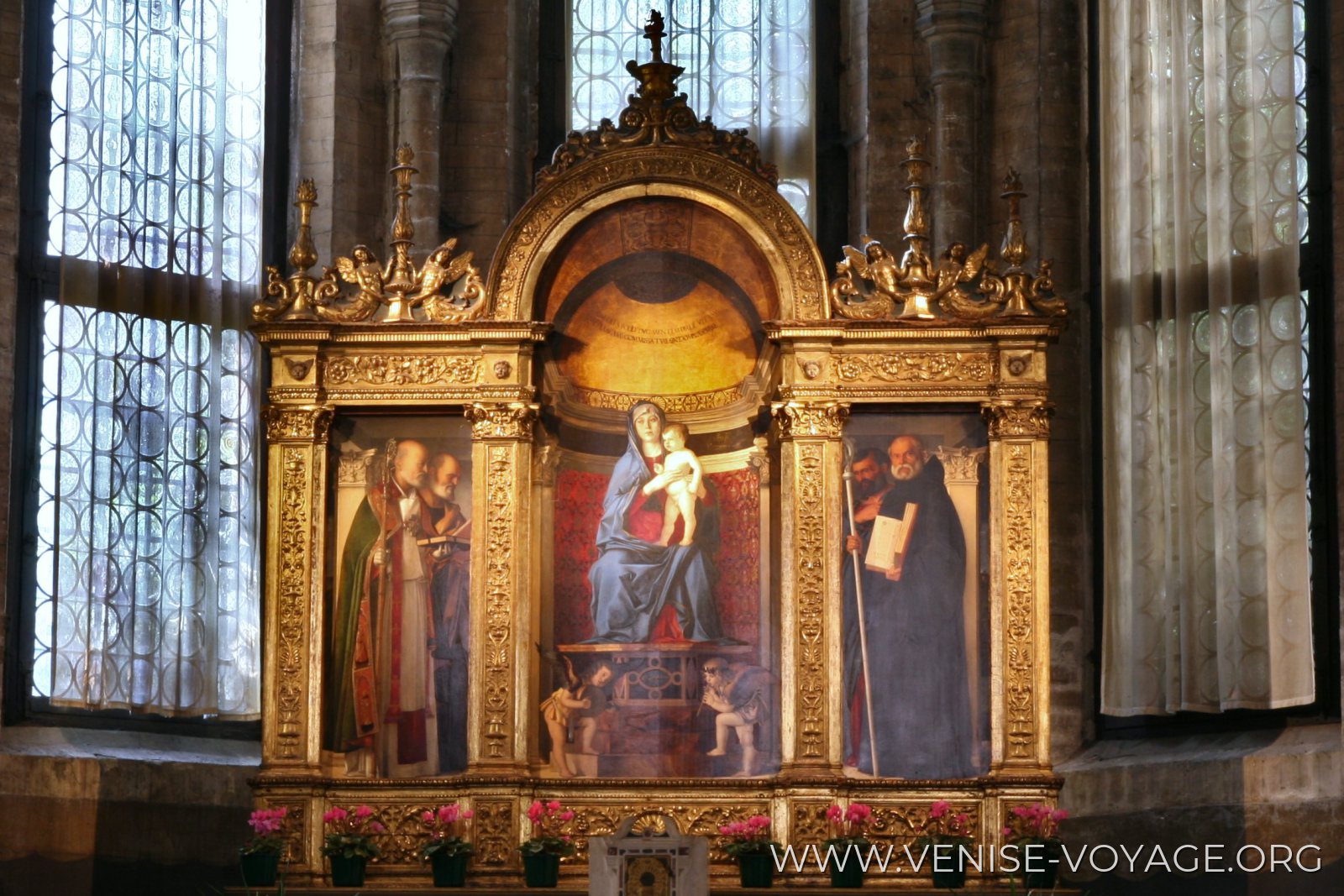
Virgin and Child, triptych by Giovanni Bellini (early 16th century)
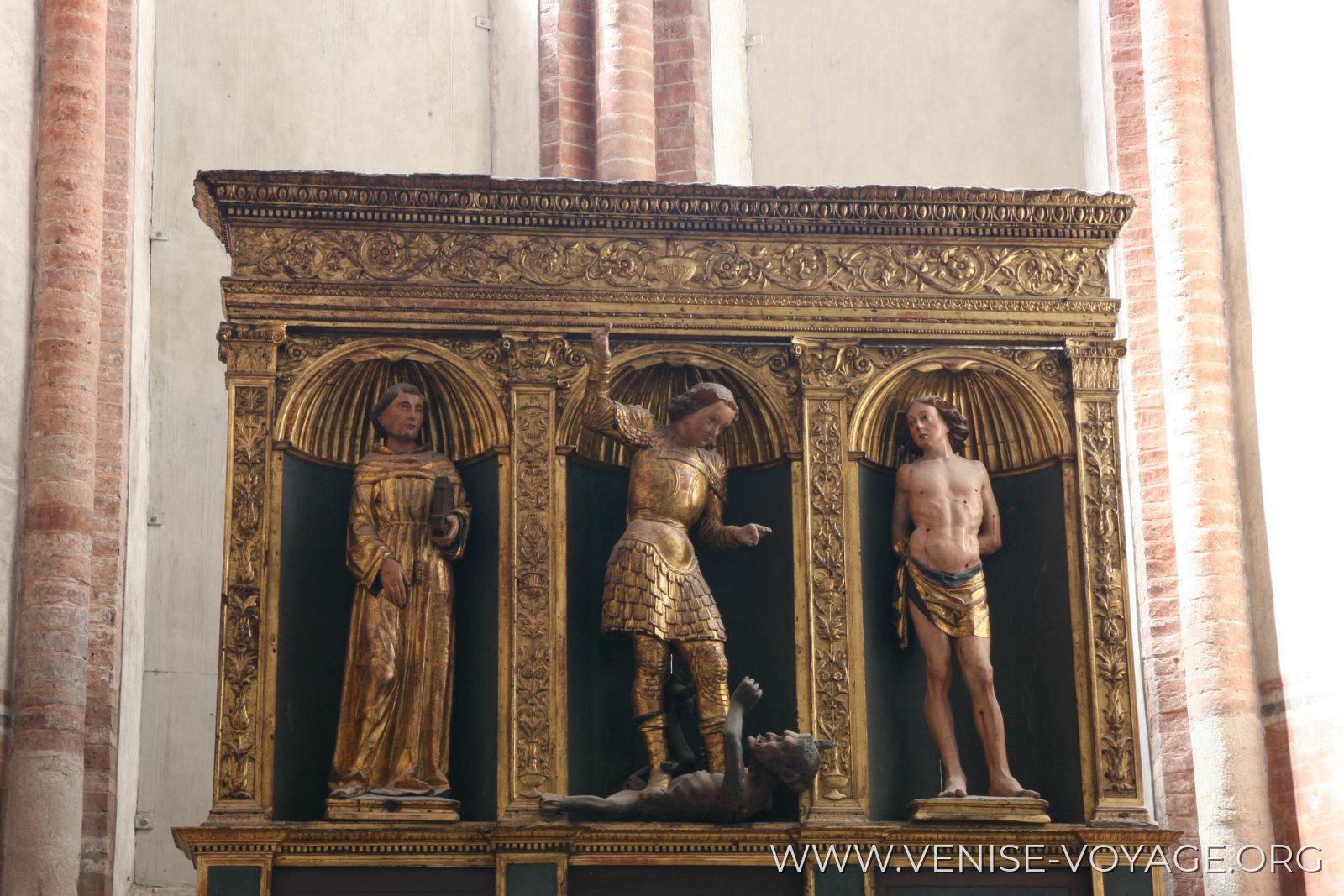
15th-century altarpiece, Saint Michael's Chapel
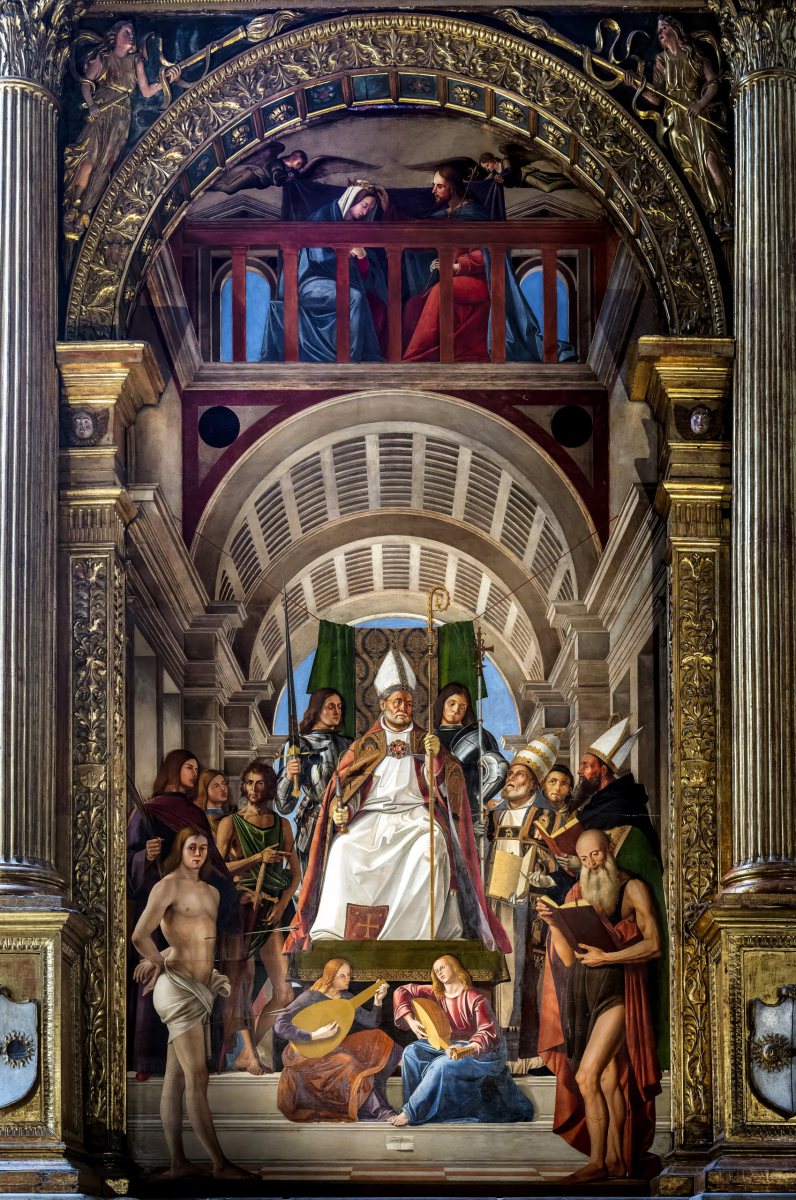
Pala di sant'Ambrogio dei Milanesi (Alvise Vivarini, via Wikimedia Commons)

Tombs of doges, artists and musicians
The Frari is also a vast place of memory of the Republic. The funerary monuments of the doges Francesco Foscari, Nicolò Tron and Giovanni Pesaro illustrate several centuries of Venetian sculpture, from the Renaissance to the baroque. One also finds the tombs of the composer Claudio Monteverdi and many patricians, soldiers and dignitaries who chose this great Franciscan church to perpetuate their memory.
The visit thus benefits from not being limited to the most famous paintings. One must observe the depth of the nave, the light on the brick, the choir, the chapels and especially the way in which paintings, altars and funerary monuments were designed for precise locations. In the Frari, architecture does not merely serve as a setting: it still organizes the reading of the works today.
The basilica also recalls the considerable weight of the mendicant orders in medieval Venice, as well as the close ties between religion, patrician families and great artists. More than an accumulation of masterpieces, the Frari thus offer a particularly readable condensation of several centuries of Venetian artistic and social history.
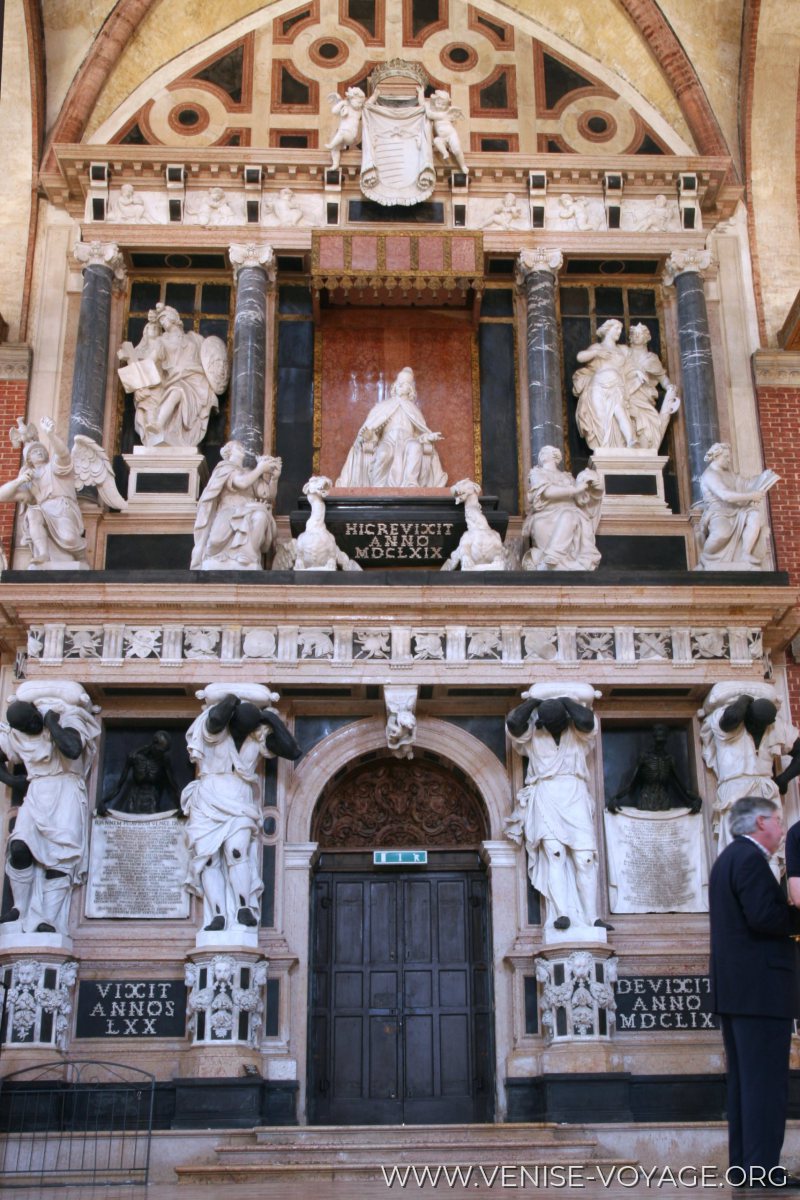
Monumento del doge Giovanni Pesaro (1665-69)
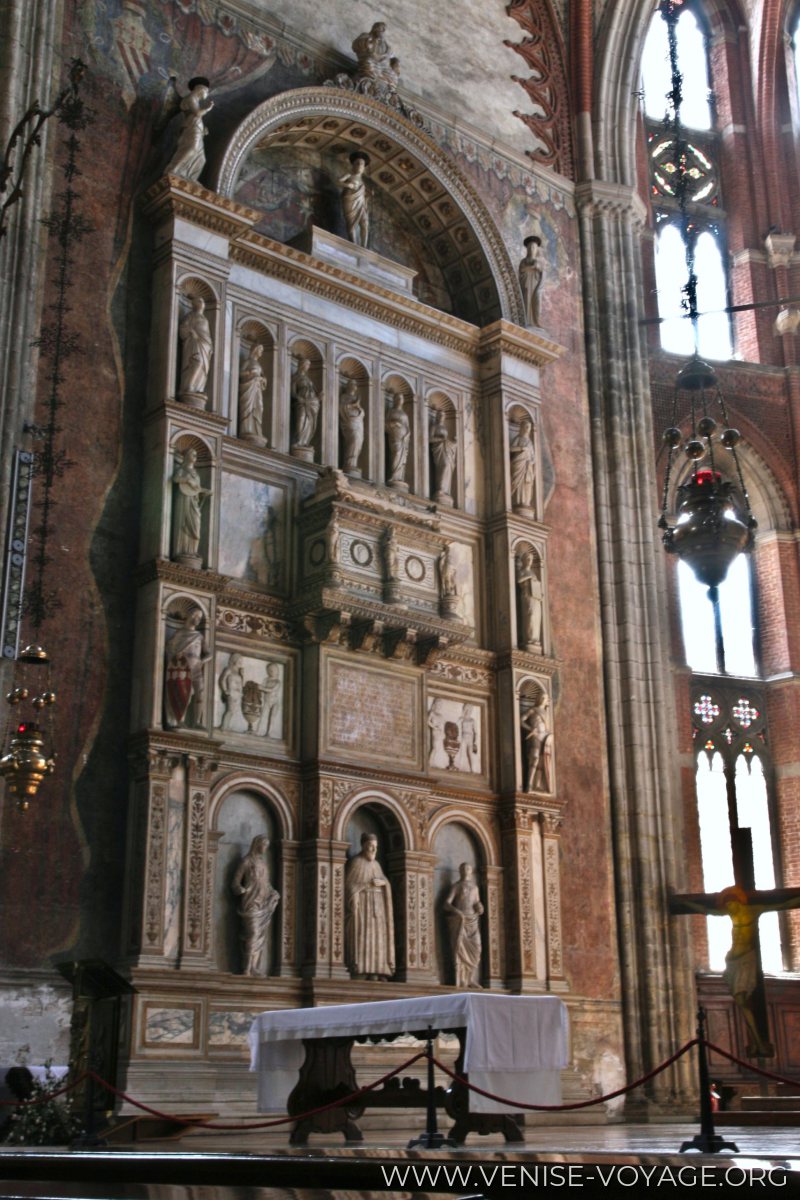
Tomb of Doge Tron (1476)
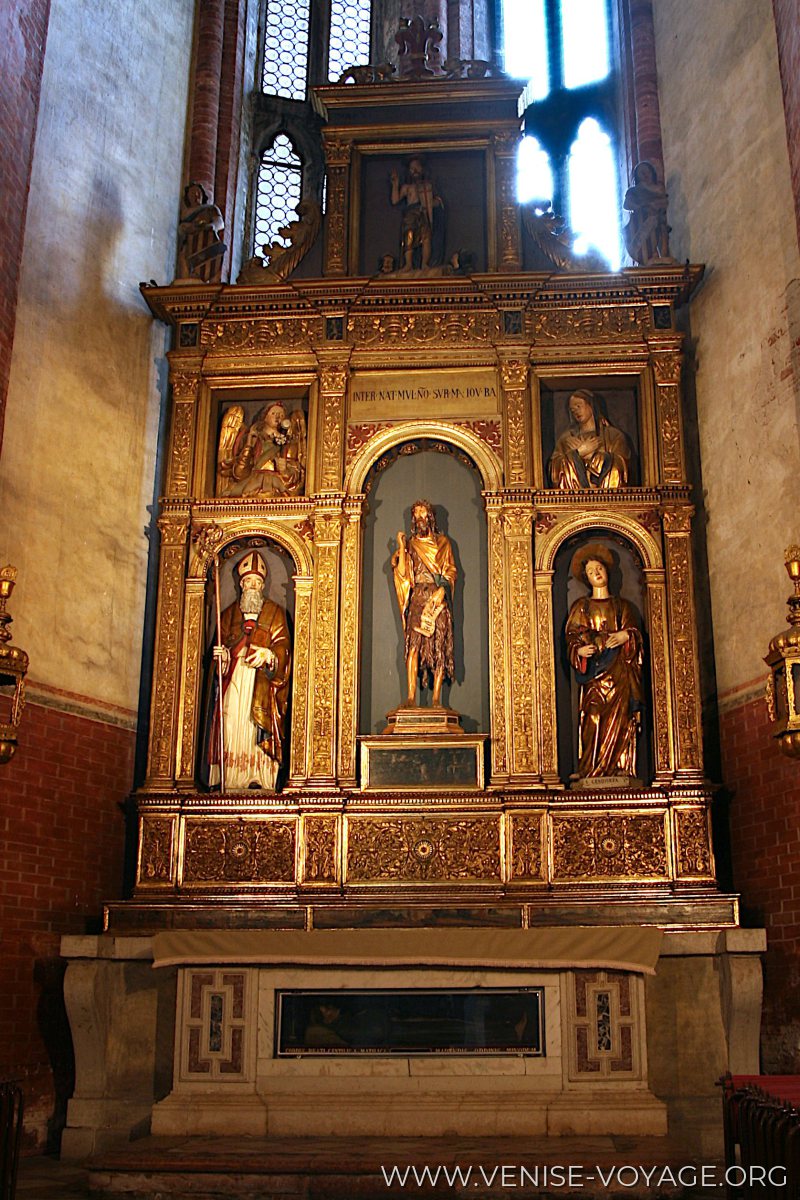
Saint John the Baptist Chapel, 15th-century altarpiece
Sources and further information
Frari on Wikipedia - Basilica dei Frari - official site ; Basilica dei Frari - paintings ; Basilica dei Frari - monuments ; Venezia Unica - Basilica dei Frari.
Map and route
Near Santa Maria Gloriosa dei Frari and places in the district
 Church
San Rocco Church
95 m
Church
San Rocco Church
95 m
 Museum
Scuola Grande di San Rocco
100 m
Square
Campo San Tomà and Scoletta dei Calegheri
116 m
Museum
Scuola Grande di San Rocco
100 m
Square
Campo San Tomà and Scoletta dei Calegheri
116 m
 Monument
Scuola Grande San Giovanni Evangelista
159 m
Monument
Scuola Grande San Giovanni Evangelista
159 m
In the San Polo sestiere

Nearby places to stay
Sur le même thème