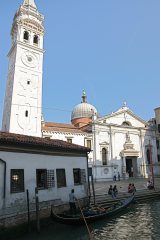
Church of San Polo Church
Church on the Campo San Polo, transformed over the centuries and rich in Venetian works of art, close to the Basilica of the Frari and the Scuola Grande di San Rocco.
Church of San Polo, from the Middle Ages to the Tiepolo
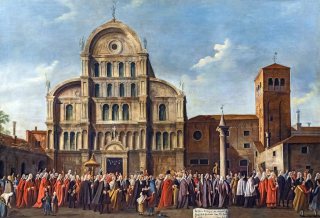
The Church of San Polo, dedicated to Saint Paul the Apostle, gave its name to the large square nearby and then to the entire sestiere. Founded in the 9th century, it is among the oldest parish churches of Venice, but its current appearance is the result of a long succession of transformations. Rather than a building belonging to a single period, San Polo thus allows one to explore several centuries of Venetian architecture and art in a relatively compact space.
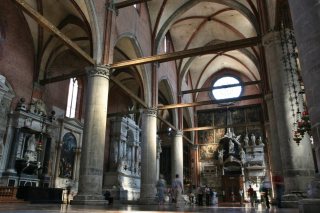
The primitive church, of Byzantine tradition, was profoundly reworked in the 15th century in a late Gothic style. The beautiful portal attributed to Bartolomeo Bon dates from this phase. A new, much more radical transformation took place in 1804: the architect Davide Rossi reorganized the interior according to Neoclassical taste. Later restorations, however, made it possible to uncover several older elements, notably the wooden ceiling and the Gothic presbytery.
Outside, the powerful campanile, detached from the church as is often the case in Venice, is one of the oldest and most recognizable elements of the whole. At its base, two stone lions recall an even more distant past and give this part of the square an almost medieval look, despite the successive transformations of the church.
A small church, a remarkable concentration of paintings
The interior, relatively sober in its organization, brings together works covering several major periods of Venetian painting. On the counter-facade is a Last Supper by Tintoretto, while another altar retains his Assumption and Saints. The presbytery is largely decorated with canvases by Jacopo Palma il Giovane, whose activity profoundly marked the religious Venice of the late 16th and early 17th centuries.
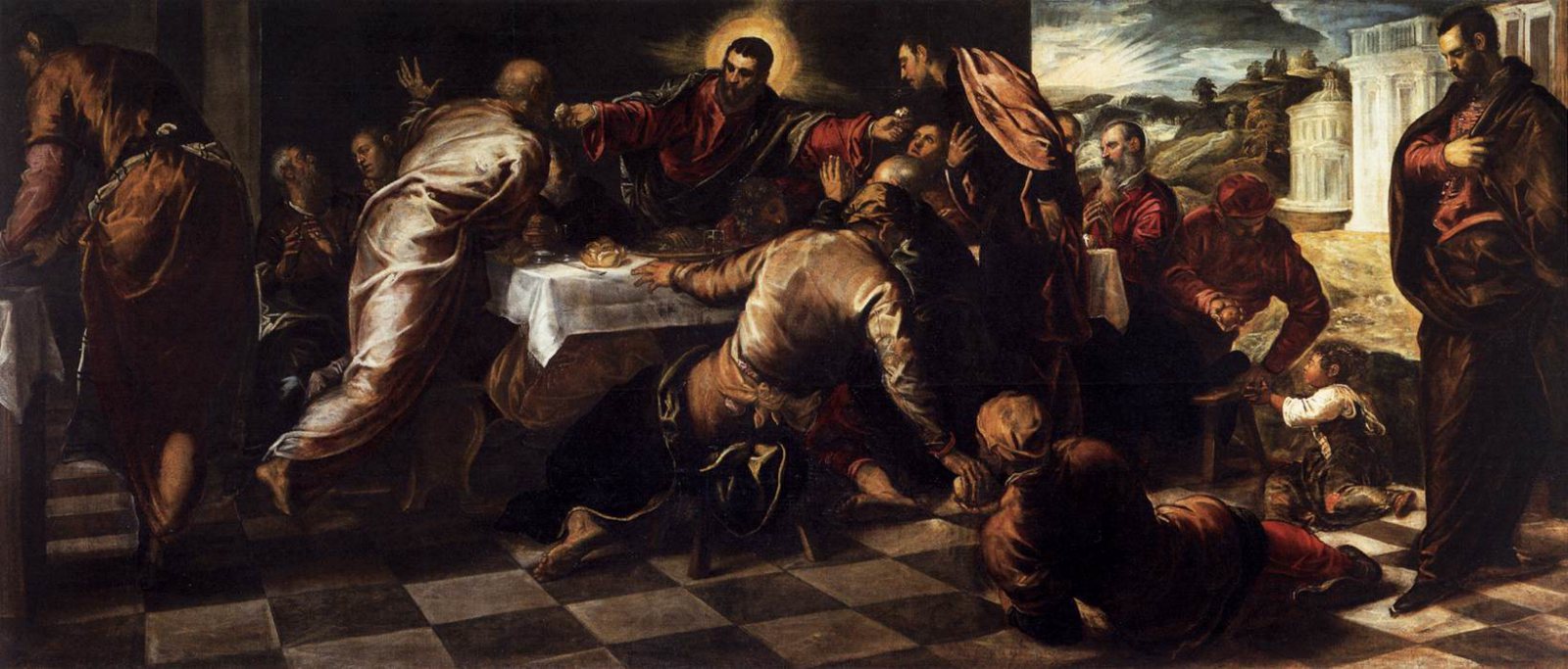
The Last Supper, Jacopo Tintoretto (1570)
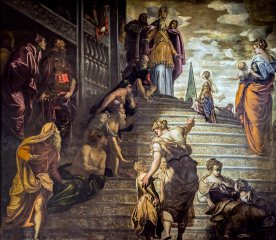
The visit reveals other important works: a Marriage of the Virgin by Paolo Veronese and, on an altar in the left aisle, The Virgin Appears to Saint John Nepomuk, painted by Giambattista Tiepolo in 1754. San Polo thus offers, without the scale of a great basilica, a remarkable condensation of several generations of Venetian masters.
One of the most interesting spaces, however, is the Oratory of the Crucifix, set up in the 18th century and accessible from the church. Its decoration is closely associated with Giandomenico Tiepolo, son of Giambattista, who developed there a more personal language, attentive to attitudes, movements, and the human dimension of religious scenes.
Another detail deserves attention: the organ built by Gaetano Callido in 1763, his first known work in Venice. Its case has an unusual composition, framed by the wooden figures of Saint Cecilia and King David, two characters traditionally associated with sacred music.
The interest of San Polo lies precisely in this superposition. Behind a parish church that may seem discreet at first glance appear a medieval origin, Gothic and Neoclassical transformations, an ancient campanile, and a pictorial ensemble where Tintoretto, Veronese, Palma il Giovane, and two generations of Tiepolo meet.
The visit naturally combines with the San Polo square, then with the Basilica of the Frari and the Scuola Grande di San Rocco, located a few minutes away. Above all, it allows visitors to understand the neighborhood beyond its great monuments: San Polo was also built around its parishes, its confraternities, its commercial activities, and these religious places deeply embedded in the daily life of Venice.
Sources and further information
Chorus Venezia - Chiesa di San Polo ; Save Venice - Church of San Polo ; Venezia Unica - San Polo.
Map and route
Near the Church of San Polo and places in the district
 Square
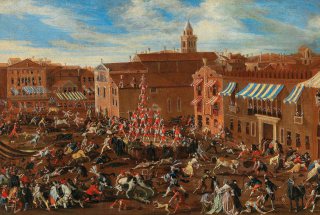
Campo San Polo
53 m
Museum
House of Carlo Goldoni
149 m
Square
Campo San Tomà and Scoletta dei Calegheri
210 m
Bridge
Ponte delle Tette
223 m
Square
Campo San Polo
53 m
Museum
House of Carlo Goldoni
149 m
Square
Campo San Tomà and Scoletta dei Calegheri
210 m
Bridge
Ponte delle Tette
223 m
In the San Polo sestiere

Nearby places to stay
Sur le même thème