Church of Santa Maria Formosa Church
One of the oldest churches in the lagoon, rebuilt by Mauro Codussi in 1492, known for its grotesque mascaron and its Polyptych by Palma the Elder.
Santa Maria Formosa, between Marian legend and Venetian grotesque
Santa Maria Formosa
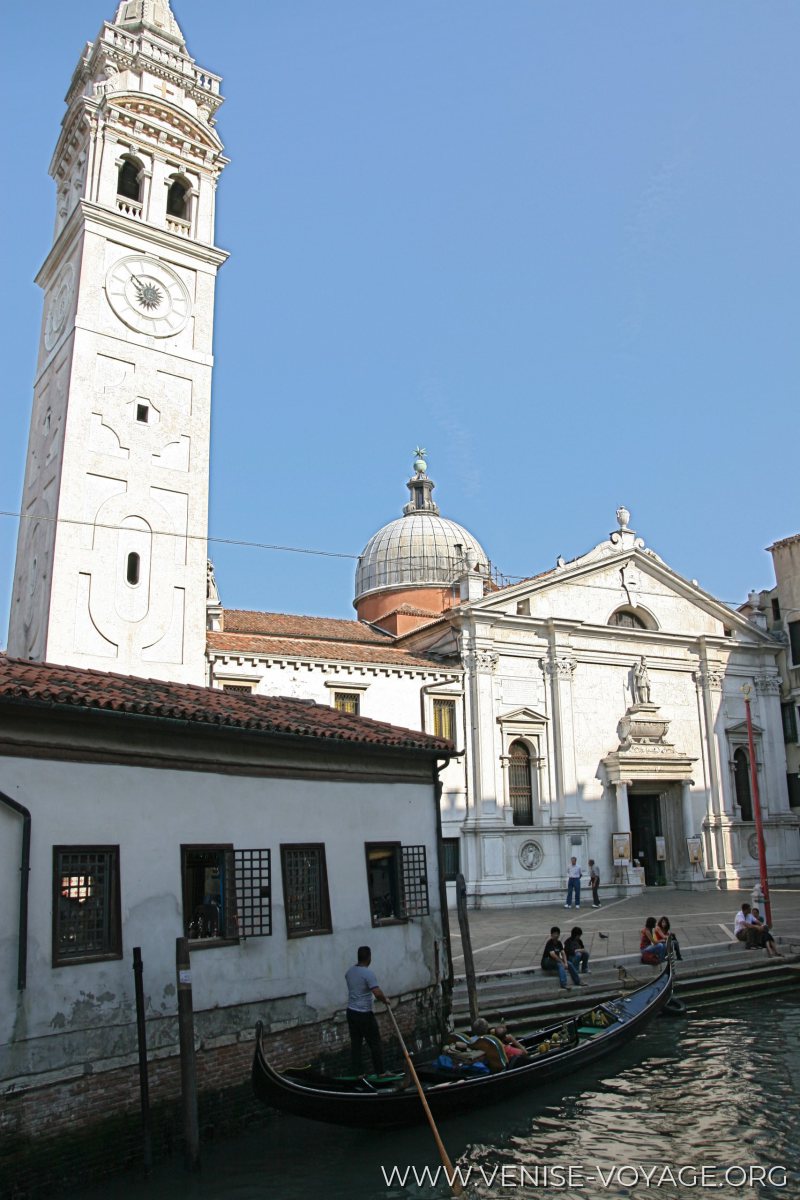
In the heart of one of the liveliest campi in Castello, the church of Santa Maria Formosa is said, according to tradition, to be among the first eight churches founded in the lagoon by Bishop Magnus of Oderzo in the 7th century. The Virgin is said to have appeared to him in the guise of a 'beautiful matron' and to have indicated the site of the sanctuary. The Latin formosa, 'beautiful' or 'well made', is thus said to have given its name to the church. Tradition remains legendary: certain documentation only appears in the 11th century, around 1060.
The current building is the result of the reconstruction begun in 1492 by Mauro Codussi, one of the main proponents of the Renaissance in Venice. It adopts a Latin cross plan with three naves, while retaining a strong centrality inherited from the earlier church, once organized on a Greek cross and already equipped with a dome.
Santa Maria Formosa has the particularity of presenting two monumental facades, both linked to the Cappello family. The one overlooking the rio, completed in 1542, adopts a classical vocabulary and also serves as a monument to Admiral Vincenzo Cappello, whose statue dominates the portal. The facade facing the campo, completed in 1604, belongs to a more Baroque language.
The dome, rebuilt after its collapse during the earthquake of 1688, dominates an interior rich in works. The most famous is the Polyptych of Saint Barbara by Palma the Elder, made around 1523-1524 for the Scuola dei Bombardieri. Saint Barbara, patron saint of artillerymen, occupies the central panel, with a cannon at her feet. The church also preserves the Triptych of the Virgin of Mercy by Bartolomeo Vivarini, dated 1473, and a Last Supper by Leandro Bassano.
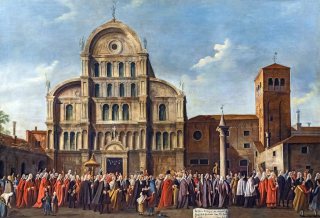
Santa Maria Formosa was also linked to the public ceremonies of the Republic. After the disappearance of the ancient Festa delle Marie, associated in tradition with the liberation of young brides abducted by pirates, the doge continued for a long time to come solemnly to pray in the church on February 2, the day of the Purification of the Virgin.
On August 9, 1916, during the First World War, an Austrian incendiary bomb struck the church and destroyed in particular its organ. The building was then restored.
The campo surrounding the church, one of the largest in Castello, mixes cafés, housing, and local traffic. Located near the Palazzo Grimani and on a natural route between San Marco and Santi Giovanni e Paolo, it is an interesting stop for discovering a monumental Venice still integrated into daily life.
Sources and further information
Chorus Venezia - Santa Maria Formosa ; Save Venice - Polyptych of Saint Barbara ; Venice in Peril - Santa Maria Formosa.
Map and route
Near the Church of Santa Maria Formosa and places in the district
 Museum
Fondazione Querini Stampalia
83 m
Museum
Palazzo Grimani
97 m
Museum
Fondazione Querini Stampalia
83 m
Museum
Palazzo Grimani
97 m
 Church
Ospedaletto (Santa Maria dei Derelitti)
243 m
Monument
Statue of Colleoni
244 m
Church
Ospedaletto (Santa Maria dei Derelitti)
243 m
Monument
Statue of Colleoni
244 m
In the Castello sestiere

Nearby places to stay
Sur le même thème