Statue of Colleoni Monument
Equestrian Renaissance statue on the Campo Santi Giovanni e Paolo, made by Verrocchio, which also recalls the territorial power of the Republic of Venice, celebrating here one of its greatest captains.
Colleoni, Bronze Horseman
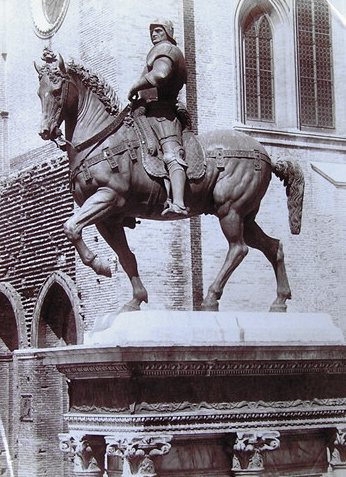
(19th-century photo)
The monument to Bartolomeo Colleoni, called Colleoni Statue, stands on the Campo Santi Giovanni e Paolo, in front of the basilica of the same name and the Scuola Grande di San Marco. In a city where horses have long disappeared from everyday life, this imposing equestrian statue immediately strikes by its energy: rider and mount seem to advance in the middle of the campo, dominating the space from their high pedestal.
At his death, Colleoni bequeathed to Venice a considerable sum, including 100,000 ducats, as well as other claims intended notably for the war against the Ottomans. His will also requested that an equestrian statue in his likeness be erected on St. Mark's Square. The Republic accepted the idea of the monument, but certainly not its location: erecting a gigantic statue celebrating a private military commander in the political heart of Venice would have been a spectacular violation of the traditions of a state particularly wary of individual ambitions.
A masterpiece of Renaissance equestrian sculpture
The Republic launched the project at the end of the 1470s and finally entrusted the monument to the Florentine Andrea del Verrocchio. He designed a composition much more tense than the famous Gattamelata executed a few decades earlier by Donatello in Padua. The horse advances powerfully, one front leg raised, while Colleoni, upright in his stirrups, turns his body slightly and fixes the space before him with a deliberately severe expression.
This tension gives the group an impression of movement unusual for such an imposing mass of bronze. Verrocchio not only seeks to represent a man on horseback: he constructs a true image of military command, where the rider's attitude, the armor, the torsion of the body, and the musculature of the animal all contribute to the same effect of power.
Verrocchio died in Venice in 1488 without having been able to cast his definitive model. The Senate then entrusted the completion to Alessandro Leopardi, a great Venetian bronze founder, who carried out the casting and also designed the remarkable marble pedestal. The whole was completed and installed during the 1490s, becoming one of the great equestrian monuments of the Italian Renaissance.
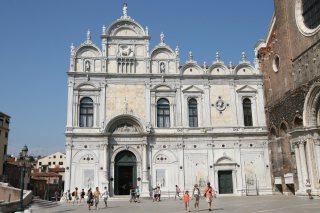
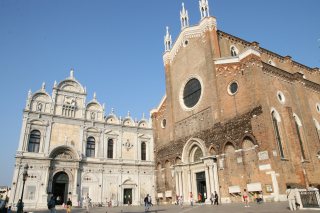
The monument also deserves to be observed in its environment. The dark bronze works in dialogue with the Gothic mass of the Santi Giovanni e Paolo Basilica and with the spectacular Renaissance façade of the Scuola Grande di San Marco. These three very different architectures form around the campo one of the most impressive monumental ensembles in Castello.
The Colleoni finally recalls an often forgotten aspect of Venice's history: behind the galleys, merchants, and palaces of the Grand Canal there was also a territorial power capable of mobilizing large armies. The Republic celebrated here one of its greatest captains, while ensuring that the bronze hero never overshadowed the power of the State.
Sources and additional information
Treccani - Bartolomeo Colleoni ; Metropolitan Museum of Art - Verrocchio and the Colleoni Monument ; Venezia Unica - Castello.
Map and route
Near the Statue of Colleoni and places in the district
 Monument
Scuola Grande di San Marco
57 m
Monument
Scuola Grande di San Marco
57 m
 Church
Basilica of Santi Giovanni e Paolo
78 m
Church
Basilica of Santi Giovanni e Paolo
78 m
 Church
Ospedaletto (Santa Maria dei Derelitti)
118 m
Church
Ospedaletto (Santa Maria dei Derelitti)
118 m
 Church
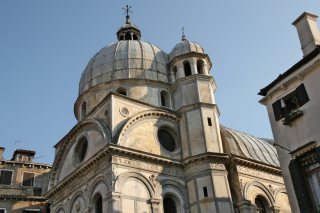
Santa Maria dei Miracoli
174 m
Church
Santa Maria dei Miracoli
174 m
In the Castello sestiere