Scuola Grande di San Marco Monument
Seat of the ancient great confraternity of Castello, it is today linked to the civil hospital and remarkable for its marble façade. With the Santi Giovanni e Paolo basilica and the monument to Bartolomeo Colleoni, the Scuola Grande di San Marco alone represents several faces of the Republic: religion, assistance, social prestige, art, and military memory.
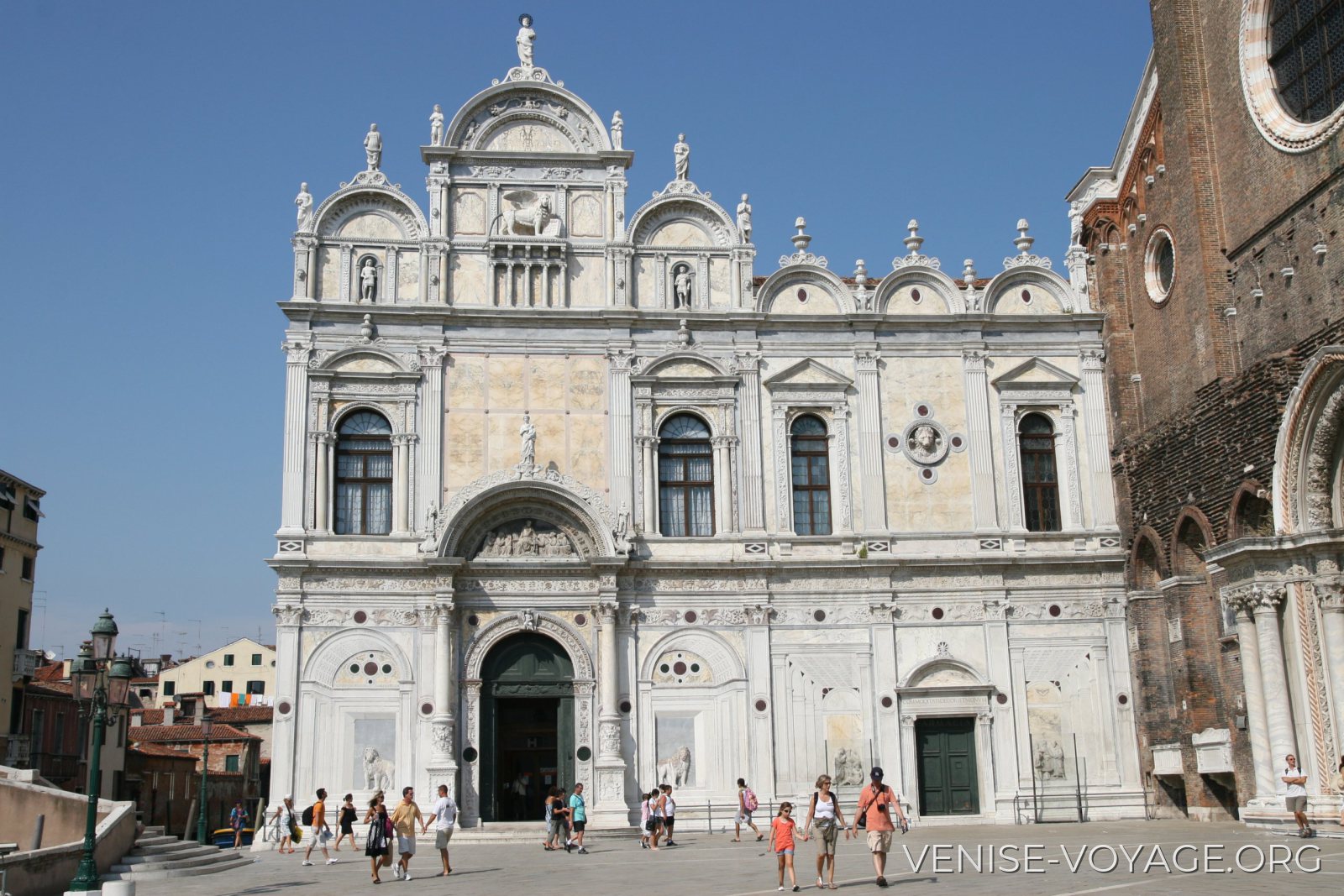
Scuola Grande di San Marco, marble and perspective
The Scuola Grande di San Marco borders the vast Campo Santi Giovanni e Paolo, in Castello. Its spectacular marble façade almost rivals the neighboring basilica and, together with Colleoni’s equestrian monument, forms one of the most impressive monumental ensembles in Venice. Despite its palatial appearance, the building was first the seat of a powerful lay confraternity dedicated to devotion and assistance.
Having become too important for its former seat, the Scuola undertook in 1437 the construction of a new building next to the Dominican convent of Santi Giovanni e Paolo. The official transfer took place in 1438. It was this first building of San Zanipolo that was almost entirely destroyed by the fire of 1485, before the monumental reconstruction of which the famous current façade remains.
The first monumental seat met a brutal end on the night of 31 March 1485. According to documents preserved by the Scuola, candles left burning on the altar of the chapter room would have communicated the fire to a tapestry: the fire destroyed in a few hours almost the entire building and its decor. The confraternity immediately decided to rebuild, this time with considerable architectural ambition.
A façade conceived as trompe-l’oeil architecture
The construction site was first entrusted to Pietro Lombardo, then continued notably by Mauro Codussi from the 1490s. White and polychrome marbles, pilasters, niches, sculptures, and relief panels transform the façade into a true manifesto of the Venetian Renaissance. The composition thus combines real architecture and represented architecture, with a sophistication unusual even in Venice.
The sculpted panels of the lower part are particularly remarkable. The reliefs of Tullio Lombardo dedicated to Saint Mark and Anianus use an extremely calculated perspective: pavements, columns, and architectures converge toward a vanishing point and give the impression that small rooms open into the thickness of the wall. Stone thus imitates the techniques of Renaissance perspective painting.
Above the portal naturally appears the lion of Saint Mark, while two sculpted lions frame the entrance. These are, however, restorations: the originals were destroyed after the fall of the Republic in 1797. Some older elements, on the other hand, had survived the fire of 1485 and were reused in the new façade.
The interior was up to this ambition. The great Sala Capitolare and the Sala dell’Albergo received at the end of the 15th century sumptuous carved and gilded ceilings. For the Sala dell’Albergo, the confraternity also commissioned an extraordinary cycle dedicated to the life of Saint Mark, on which notably worked Gentile and Giovanni Bellini, Giovanni Mansueti, Paris Bordone, and Palma the Elder.
A large part of these paintings was dispersed after the fall of the Republic and the Napoleonic suppressions. Several of the famous teleri of the Scuola are today preserved at the Gallerie dell’Accademia, where they still constitute a major ensemble of Venetian Renaissance narrative painting. The Scuola, however, retains its historical ceilings as well as various works from the 16th and 17th centuries.
The destiny of the building changed profoundly in the 19th century with the development of the Ospedale Civile di Venezia in the neighboring old Dominican complex. The Scuola was gradually integrated into this hospital complex, and its Sala Capitolare now notably houses an important library dedicated to the history of medicine. The place thus combines in a rather singular way Renaissance heritage, the history of charity, and health activity.
The Scuola is today again accessible as part of its museum and cultural activity. Even a careful observation from the campo allows one to grasp its originality: rarely in Venice has a confraternity used with such effectiveness marble, sculpture, and perspective as instruments of public representation.
Sources and further information
Scuola Grande di San Marco - official website ; Gallerie dell’Accademia di Venezia ; Venezia Unica - Castello.
Map and route
Near Scuola Grande di San Marco and places in the district
 Church
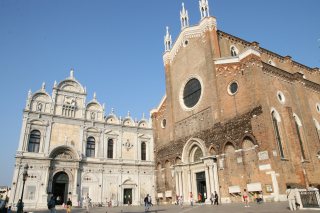
Basilica of Santi Giovanni e Paolo
90 m
Church
Basilica of Santi Giovanni e Paolo
90 m
 Church
Ospedaletto (Santa Maria dei Derelitti)
144 m
Church
Ospedaletto (Santa Maria dei Derelitti)
144 m
 Church
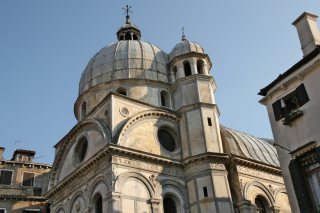
Santa Maria dei Miracoli
180 m
Church
Santa Maria dei Miracoli
180 m
In the Castello sestiere