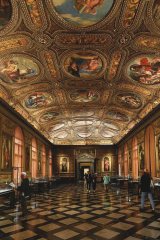
Palazzo Grimani Museum
Renaissance palace inspired by ancient Roman domus, residence of the Grimani family that became a state museum in 2008, famous for its ancient Tribuna.
Palazzo Grimani, a residence inspired by ancient Rome
Not far from Campo Santa Maria Formosa, in the Castello sestiere, the Palazzo Grimani was acquired at the end of the 15th century by the patrician Antonio Grimani, a leading figure in the political and military life of the Republic, elected doge in 1521. Handed down to his four sons, the residence became the home of this branch of the family, henceforth known as “di Santa Maria Formosa”.
In the 16th century, his grandsons Vettore and Giovanni Grimani substantially enlarged the medieval building. Two new wings were added around an inner courtyard with loggias, following an organization inspired by ancient Roman dwellings and Renaissance architecture. This “alla romana” architectural culture is particularly unique in Venice, where Gothic and Byzantine traditions still prevailed.
The monumental staircase, adorned between 1563 and 1565 by Federico Zuccari, leads to the piano nobile through a set of allegories, grotesques and stuccoes inspired in part by the ancient gems collected by the Grimani. Marbles, niches and painted ceilings were designed to dialogue with the ancient sculptures of the residence.
The palace also preserves the camerini of Apollo, Callisto and Psyche, decorated between 1537 and 1540 in a Mannerist idiom. Francesco Salviati notably worked in the Camerino di Apollo, while Giovanni da Udine, a former collaborator of Raphael, deploys his art of stuccoes and grotesques there. The private chapel retains a 16th-century canvas attributed to Giovanni Contarini, a follower of Titian.
The dining room has a ceiling painted around 1567 by Camillo Mantovano, populated with festoons, flowers, fish, vegetables and game. In the Sala a Fogliami (leaf room), the same artist transforms the ceiling into a lush vegetation populated with animals. The symbolic figures in the lunettes allude to the long heresy trial undergone by Giovanni Grimani, which compromised his accession to the cardinalate.
Acquired by the Italian State in 1981 when it was severely degraded, the palace underwent a long restoration before opening to the public as a museum in December 2008. Since 2024, it comes under the Musei archeologici nazionali di Venezia e della Laguna. Its interest lies as much in the works displayed as in the palace itself, a rare Venetian example of a residence profoundly marked by the Roman architectural culture of the 16th century.
Sources and further information
Museo di Palazzo Grimani - Musei archeologici nazionali di Venezia e della Laguna ; Museo di Palazzo Grimani - Ministero della Cultura ; Venetian Heritage - Domus Grimani 1594-2019.
Map and route
Near the Palazzo Grimani and places in the district
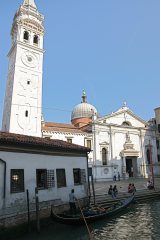 Church
 of Santa Maria Formosa
97 m
Church
Church of Santa Maria Formosa
97 m
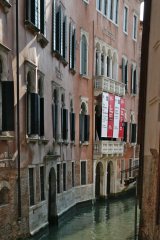 Museum
Fondazione Querini Stampalia
119 m
Museum
Fondazione Querini Stampalia
119 m
 Church
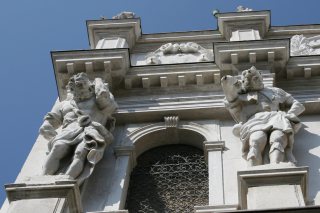
Ospedaletto (Santa Maria dei Derelitti)
210 m
Church
Ospedaletto (Santa Maria dei Derelitti)
210 m
 Church
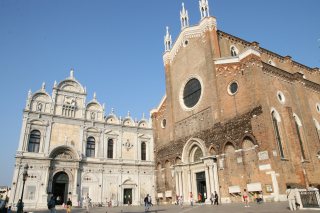
Basilica of Santi Giovanni e Paolo
252 m
Church
Basilica of Santi Giovanni e Paolo
252 m
In the Castello sestiere
Nearby places to stay
Sur le même thème