Scuola Grande della Misericordia Monument
Imposing Renaissance edifice in Cannaregio designed by Jacopo Sansovino for one of the great confraternities of Venice, today a cultural and event venue, also famous for having housed a basketball court from 1914 to 1991.
The Scuola Grande della Misericordia
At the end of the Fondamenta della Misericordia, this immense brick building ranks among the most imposing civic buildings in Cannaregio. Designed by Jacopo Sansovino, the Scuola Grande della Misericordia bears witness to the power of the scuole grandi, those lay confraternities that played a religious, charitable, and social role in Venice while vying in prestige through their monumental seats.
The confraternity of Santa Maria della Misericordia dates back to 1261. Settled from 1308 in a first neighboring school, now called Scuola Vecchia, it became important enough to envisage a much larger seat. Construction of a new building was authorized as early as 1498, but the wars of the early 16th century delayed the work. In 1531, Sansovino's project was finally selected.
A monumental project left unfinished
Sansovino imagined a building commensurate with the wealth of the confraternity. The work progressed slowly, however, and at the architect's death in 1570, the complex was still far from finished: the upper floor notably had neither finished flooring nor a permanent staircase. Financial difficulties led to a simplification of the program, and the stone facade originally planned was never realized. The exposed brick, today one of the most characteristic features of the Misericordia, thus bears witness to a Renaissance project that remained partially unfinished. The building was finally inaugurated in 1583.
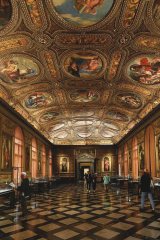
The interior offers a better measure of Sansovino's ambition. The ground floor, about 1,000 m², is organized into three naves separated by powerful paired columns, almost like a basilica transformed into a civil space. On the upper floor stretches a chapter hall of comparable dimensions, entirely free of intermediate supports and more than twelve meters high: one of the largest meeting spaces in historic Venice.
Between 1606 and 1609, its walls were decorated by artists from the school of Paolo Veronese. Large figures of prophets, painted in chiaroscuro amid feigned architectures, give the illusion of monumental sculptures and visually extend the lines of the room. A significant part of this decoration still survives today.
From the confraternity to the cultural venue
The confraternity had disappeared long before: suppressed under Napoleonic domination in 1806, the Scuola was thereafter used notably for military purposes. The City of Venice acquired it in 1899. After the sporting period and several decades of transformations, a major restoration carried out in the 2010s made it possible to rediscover the monumentality of the spaces without seeking to conceal the different stages of their history.
The Misericordia reopened in April 2016 as a cultural and event space. Exhibitions, artistic installations, events related to architecture or fashion, film shoots and receptions now occupy the same halls that successively welcomed Renaissance confreres and basketball players. Few Venetian monuments encapsulate so well, in a single building, five centuries of very different uses.
Visit: the Scuola Grande della Misericordia does not function as a museum open daily. Access depends on the scheduled exhibitions and events; it is therefore advisable to consult the official website before going there.
Sources and further information
Misericordia di Venezia – history of the Scuola ; Misericordia di Venezia – architecture and spaces ; Umana Reyer Venezia – history of the club ; FAI – Scuola Grande della Misericordia.
Map and route
Near the Scuola Grande della Misericordia and places in the district
In the Cannaregio sestiere

Nearby places to stay
Sur le même thème