Santa Maria di Nazareth Church
Baroque church of the Discalced Carmelites on the Grand Canal near Santa Lucia station, known for its unique façade in Carrara marble and the tomb of the last Doge of Venice.
Santa Maria di Nazareth, known as the Scalzi
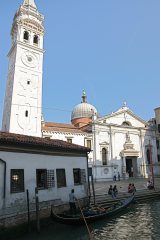
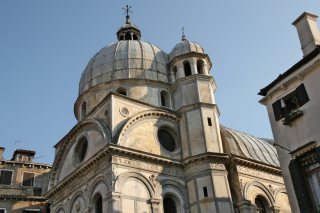
On the Grand Canal, right next to Santa Lucia station and the Scalzi Bridge, Santa Maria di Nazareth is often one of the first monuments encountered by travellers arriving in Venice by train. Behind its spectacular facade entirely clad in Carrara marble lies one of the most representative interiors of Venetian Baroque, where polychrome marbles, sculptures, frescoes and gilding create a particularly theatrical setting.
The church owes its nickname to the Discalced Carmelites, or scalzi, who settled in Venice in 1633. After several temporary locations, the order acquired houses and land in 1649 in this then peripheral district of Cannaregio, near the former church of Santa Lucia. The construction of the new church was entrusted to the great architect Baldassare Longhena in the mid-1650s. The facade was then built between 1672 and 1680 to a design by Giuseppe Sardi, thanks in particular to funding from the Cavazza family. The church, dedicated to Our Lady of Nazareth, was consecrated in October 1705, while its interior decoration was still being enriched.
A monumental facade on the Grand Canal
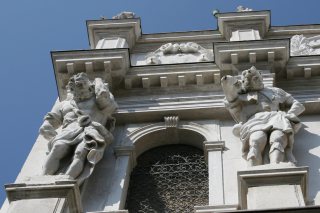
About 25 metres wide and 26 metres high, the facade is in itself a true sculpted composition. Two levels of coupled columns with Corinthian capitals, niches and an abundant decoration of statues organise the whole around the Virgin and Child placed in the centre of the upper section. Saints, biblical figures and allegorical characters complete this staging, while the Cavazza coats of arms recall the essential role played by the patrons in the realisation of the monument.
The interior is less a contrast to the facade than an extension of it. Longhena designed a vast single nave flanked by six side chapels, leading to a raised presbytery. The walls are animated with precious marbles, pilasters, gilded capitals, statues of apostles and doctors of the Church. The eye is especially drawn to the high altar, designed by the Carmelite Giuseppe Pozzo, where powerful twisted columns support a monumental structure evoking a baldachin.
Around the presbytery is a particularly original ensemble of twelve Sibyls. These prophetesses of pagan antiquity, interpreted by Christian tradition as announcing the coming of Christ, were sculpted by several Venetian artists, among them Giuseppe Torretti, Giovanni Marchiori, Pietro Baratta and the brothers Giuseppe and Paolo Groppelli. Their presence at the very heart of the sanctuary participates in the church’s complex iconographic programme.
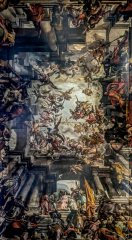
Tiepolo, Saint Teresa and the Baroque chapels
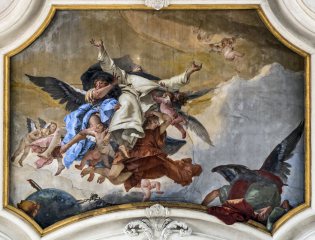
Fortunately, the loss of the great ceiling did not deprive the church of all of Tiepolo’s works. In the Saint Teresa Chapel, in 1724 he painted the Glorification of Saint Teresa of Avila, depicted rising towards heaven while an angel is about to crown her. Below is the spectacular marble group of Saint Teresa in Ecstasy, made by the German-born sculptor Heinrich Meyring, also known in Venice as Enrico Merengo. The work represents the saint’s mystical experience before the angel holding the dart of her transverberation.
Several other chapels deserve attention. The Chapel of the Crucifix preserves a Christ on the Cross by Giovanni Maria Morlaiter beneath another Tiepolo fresco devoted to Christ in the Garden of Gethsemane. The San Giovanni Battista Chapel, designed by Longhena, features the statue of the saint by Melchior Barthel amid a spectacular setting of dark marbles. The doors, altars and walls of several chapels combine bronze, semi-precious stones, coloured marbles and delicate inlay motifs, giving a good idea of the late 17th-century Venetian taste for sumptuous decoration.
The last Doge of Venice
One of the most remarkable tombs is that of Ludovico Manin, the one hundred and twentieth and last Doge of the Republic of Venice. Elected in 1789, he found himself at the head of the Serenissima when it collapsed under the pressure of the French armies in May 1797. Died in 1802, he rests in the Chapel of the Holy Family belonging to his family. His tomb gives this church, built at the peak of baroque Venice’s artistic power, a singular historical dimension: less than a century after its consecration, it welcomed the man who had witnessed the disappearance of the thousand-year Republic.
Behind the church and the former convent there also remains the Carmelites’ brolo, the old monastic garden now known as the Giardino Mistico. Restored and reopened to the public for guided visits, it perpetuates in particular the religious community’s tradition of growing aromatic plants, including that linked to the famous Acqua di Melissa produced by the Carmelites since the 18th century.
Sources and further information
Chiesa degli Scalzi – official website ; Carmelitani Scalzi – history, architecture and works of Santa Maria di Nazareth ; Catalogo Generale dei Beni Culturali – Chiesa degli Scalzi ; Gallerie dell’Accademia – Tiepolo, Il Trasporto della Santa Casa di Loreto.
Map and route
Near Santa Maria di Nazareth and places in the district
In the Cannaregio sestiere

Nearby places to stay
Sur le même thème