Ca’ d’Oro Museum
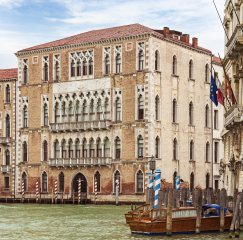
Gothic palace on the Grand Canal, today the Galleria Giorgio Franchetti, famous for its once-gilded facade.
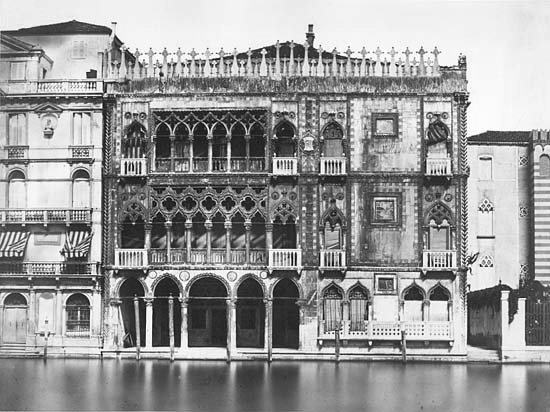
Ca’ d’Oro, Gothic on the Grand Canal
Ca’ d’Oro is one of the most emblematic palaces on the Grand Canal. Located in the sestiere of Cannaregio, it was built between 1421 and 1440 for the wealthy Venetian merchant Marino Contarini, on the site of an older residence. The construction brought together Lombard craftsmen led by Matteo Raverti and Venetian masters Giovanni Bon and his son Bartolomeo.
A facade once covered in colors and gold
The facade on the Grand Canal strikes by its asymmetry: wide openwork loggias occupy a large part of the elevation, while a more solid area is pierced by isolated windows. Polylobed arches, tracery, slender colonnettes, pinnacles, and marbles compose an almost jagged surface, characteristic of late Venetian Gothic.
The current appearance, dominated by light stone, differs greatly from the 15th-century decoration. Marino Contarini called upon the French painter Jean Charlier, known as Zuane de Franza, to enhance the facade with red, ultramarine blue, black, white, and gold. The gilding particularly highlighted the sculpted parts and the tops of the pinnacles, giving the palace its name of « House of Gold ».
From aristocratic palace to museum
Having passed through several owners, Ca’ d’Oro was profoundly transformed over the centuries and was in a very deteriorated state when Baron Giorgio Franchetti bought it in 1894. He undertook to restore as much as possible its old character, had the Gothic staircase of the courtyard reconstructed, and reinstalled the wellhead sculpted in 1427 by Bartolomeo Bon. He also designed the spectacular opus sectile pavement of the atrium, inspired by early Christian and St. Mark’s Basilica models: this floor is therefore not a vestige of the 15th century.
Franchetti donated the palace and the core of his collections to the Italian state in 1916. The Galleria Giorgio Franchetti alla Ca’ d’Oro opened to the public in 1927 and was subsequently enriched with works from public collections and vanished Venetian buildings. It houses paintings, sculptures, bronzes, tapestries, and decorative arts.
Among the major works are the Saint Sebastian by Andrea Mantegna, installed in a marble chapel designed by Franchetti, the Venus with a Mirror by Titian, the Portrait of Marcello Durazzo by Van Dyck, and views of Venice by Francesco Guardi. The second floor also preserves fresco fragments painted by the young Titian in 1508 for the Fondaco dei Tedeschi.
The interest of the place lies in the dialogue between architecture and collection. The courtyard, the loggias, and the rooms allow one to read both a patrician residence open onto the Grand Canal and Franchetti’s museum project. From the loggias, the canal remains fully integrated into the palace and recalls the role of this great waterway in the social representation of Venetian families.
Sources and further information
Galleria Giorgio Franchetti alla Ca’ d’Oro - history of the palace and museum ; Galleria Giorgio Franchetti alla Ca’ d’Oro - collections ; Venezia Unica - Cannaregio.
Map and route
Near Ca’ d’Oro and places in the district
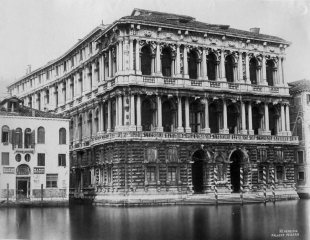 Museum
Ca’ Pesaro
215 m
Monument
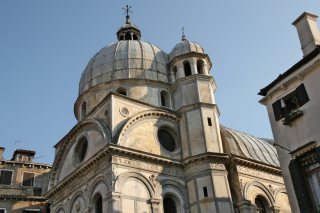
Scuola Grande della Misericordia
259 m
Museum
Ca’ Pesaro
215 m
Monument
Scuola Grande della Misericordia
259 m
 Church
San Giovanni Elemosinario Church
261 m
Church
San Giovanni Elemosinario Church
261 m
In the Cannaregio sestiere

Nearby places to stay
Sur le même thème