Ca’ Pesaro Museum
Grand Baroque palace by Baldassare Longhena on the Grand Canal, now a museum of modern art and Oriental art.
Ca’ Pesaro, Baroque palace and modern art
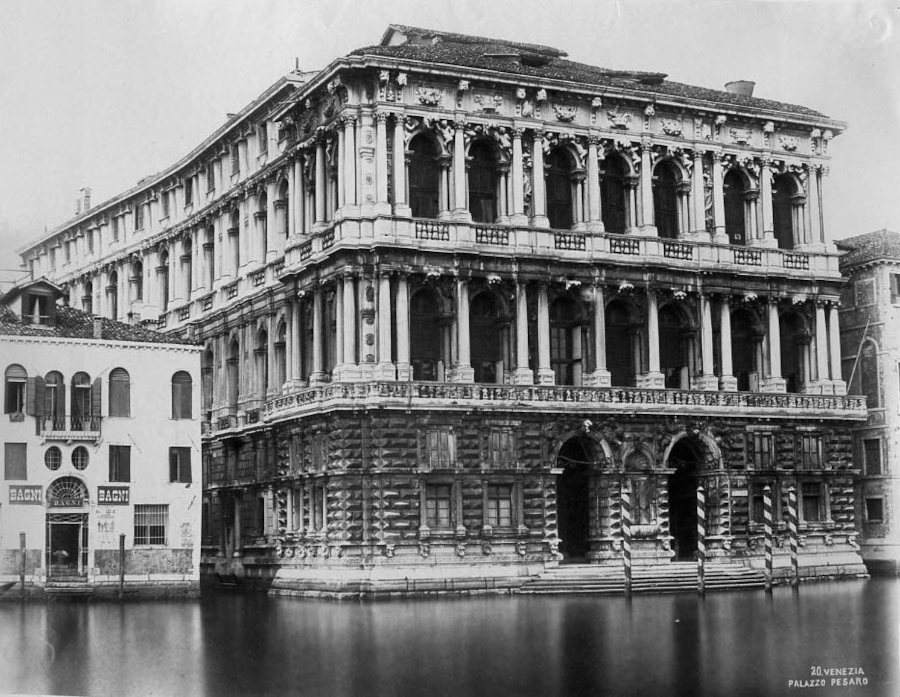
Ca’ Pesaro stands directly on the Grand Canal, in the sestiere of Santa Croce, with one of the most imposing Baroque facades in Venice. The palace is one of the great achievements of Baldassare Longhena, the architect of Santa Maria della Salute and Ca’ Rezzonico. In this project, Longhena revives certain principles of Venetian classicism inherited from Sansovino, but gives them a monumentality and sculptural power characteristic of the Baroque.
A visit to Ca’ Pesaro thus combines three interests rarely found in a single place: a grand Venetian Baroque palace, an important collection of modern and contemporary art, and a museum devoted to Asian arts. The rooms and the openings onto the Grand Canal constantly remind visitors that the works are exhibited in a monument that is itself an essential part of the visit.
Finally, in Santa Croce, Ca’ Pesaro is set in a particularly rich stretch of the Grand Canal, near San Stae and, a little further, the Fontego dei Turchi. It is one of the main cultural hubs of this part of Venice.
An architecture designed to impress
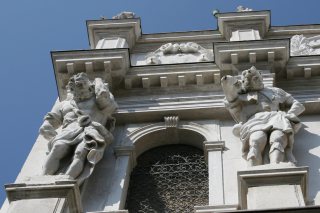
The facade on the Grand Canal combines a powerful base with diamond-point rustication, decorated with lion heads and sculpted figures, with two upper floors widely opened by windows and structured by columns. The whole remains very ordered despite the abundance of decoration. Inside, the large androne crosses the palace from the water entrance to the courtyard, organized around a monumental wellhead.
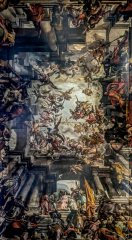
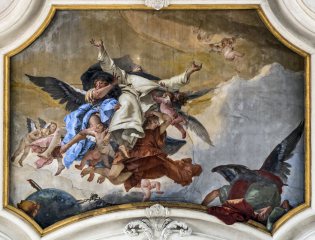
The apartments were also richly decorated. Several ceilings retain works by 17th and 18th century Venetian painters, including Giovanni Battista Pittoni, Nicolò Bambini and Giambattista Crosato. Part of the decorations and collections of the Pesaro family were however dispersed after the disappearance of its last heir in 1830.
From an aristocratic palace to a hub of modern art
After changing owners several times, Ca’ Pesaro returned to Felicita Bevilacqua La Masa. Upon her death in 1898, she bequeathed the palace to the city of Venice with the wish that it serve in particular to support young artists. In 1902, the city officially installed there the International Gallery of Modern Art. Its historical core was formed especially through acquisitions made by the city during the first Venice Biennales, to which many legacies and donations were added.
The collections now trace the evolution of art from the 19th and 20th centuries to contemporary creation. They notably include works by Gustav Klimt, Auguste Rodin, Umberto Boccioni, Medardo Rosso, Giorgio de Chirico, Giorgio Morandi, Wassily Kandinsky and Joan Miró. Among the most famous pieces are Judith II by Klimt and a version of The Thinker by Rodin.
A museum of Oriental art on the top floor
Ca’ Pesaro also houses, on its top floor, the Venice Museum of Oriental Art, a state museum inaugurated in 1928. Its main core comes from the collection assembled at the end of the 19th century by Prince Enrico di Borbone, Count of Bardi, during his travels in the Far East. The ensemble is particularly remarkable for the Japanese art of the Edo period: samurai weapons and armor, lacquerware, paintings, textiles and art objects, to which are added notably Chinese and Indonesian collections.
Sources and info
Ca’ Pesaro - MUVE: history and architecture of the palace ; Ca’ Pesaro - MUVE: collections of the International Gallery of Modern Art ; Museo d’Arte Orientale di Venezia: history of the collection ; Venezia Unica - Ca’ Pesaro.
Map and route
Near the Ca’ Pesaro and places in the district
 Church
San Stae
73 m
Church
San Stae
73 m
 Museum
Mocenigo Palace-Museum
124 m
Palace
Ca’ Vendramin Calergi
211 m
Museum
Mocenigo Palace-Museum
124 m
Palace
Ca’ Vendramin Calergi
211 m
 Museum
Ca’ d’Oro
215 m
Museum
Ca’ d’Oro
215 m
In the Santa Croce sestiere

Nearby places to stay
Sur le même thème