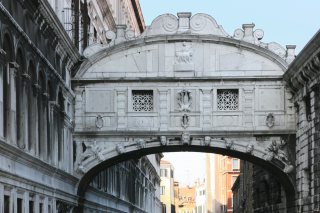
Santa Maria Assunta dei Gesuiti Church
Baroque church in Cannaregio rebuilt in the 18th century by the Jesuits, famous for its white and green marble decor imitating fabrics, with works by Titian and Tintoretto.
Santa Maria Assunta, also known as the Gesuiti
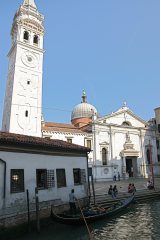
On the Campo dei Gesuiti, near the Fondamente Nove, Santa Maria Assunta is one of the most spectacular expressions of late Baroque in Venice. The interior surprises with its white and green decor transforming walls, altars, and pulpit into a vast play of stone fabrics. The current church, however, occupies a much older site: a church of the Crociferi is attested there as early as 1148, soon associated with a hospice for the poor and the sick.
From the Crociferi to the Jesuits
Expelled from the Republic during the Interdict of 1606, the Jesuits were only allowed to return in 1657. The order of the Crociferi having been suppressed in 1656, their former complex passed to the Jesuits. At the beginning of the 18th century, they undertook a reconstruction with the financial support of the Manin family. The project of Domenico Rossi, documented from 1710, was approved in 1713 and the construction site started in 1714. The facade was realized between 1721 and 1728; the interior decor continued to be completed until around 1734-1735.
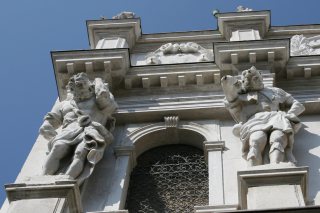
The two-order facade, also designed by Rossi, multiplies columns, niches, and sculptures. The twelve apostles occupy the different levels and the crowning is dominated by the group of the Assumption by Giuseppe Torretti. Inside, the single nave bordered by three chapels on each side leads to the high altar of Giuseppe Pozzo, whose baldachin rests on twisted columns of verde antico marble.
Masterpieces inherited from the former church
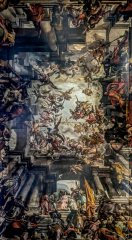
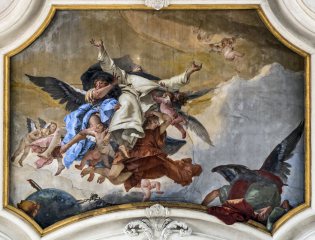
The 18th-century reconstruction preserved several works by the Crociferi. The first chapel on the left preserves the Martyrdom of Saint Lawrence by Titian, painted around 1558 for the old church. In the transept is the Assumption of the Virgin by Tintoretto, dated 1555. On the counter-facade, the funerary monument of the Da Lezze, designed by Jacopo Sansovino in the 16th century, was also reassembled. Finally, the sacristy houses about twenty paintings by Palma the Younger.
Visit: the church remains dedicated to worship. A restoration programme funded by the PNRR, with about 4.5 million euros, has concerned in particular the decorated surfaces, the facade, and the roofs. The construction site was organized to maintain services and visits as much as possible; in 2026, the official website indicates a conclusive phase of the works. As opening hours and access conditions are subject to change, it is better to check them before visiting.
Sources and further information
Fulvio Lenzo – Domenico Rossi and Santa Maria Assunta dei Gesuiti ; Treccani – History of Venice ; Ministry of Culture – The Martyrdom of Saint Lawrence by Titian ; Ministry of Culture – PNRR restoration of the Chiesa dei Gesuiti.
Map and route
In the Cannaregio sestiere

Nearby places to stay
Sur le même thème