Church of the Redeemer Church
Palladio's masterpiece, built as a vow against the plague, overlooking the Giudecca Canal with its white facade.
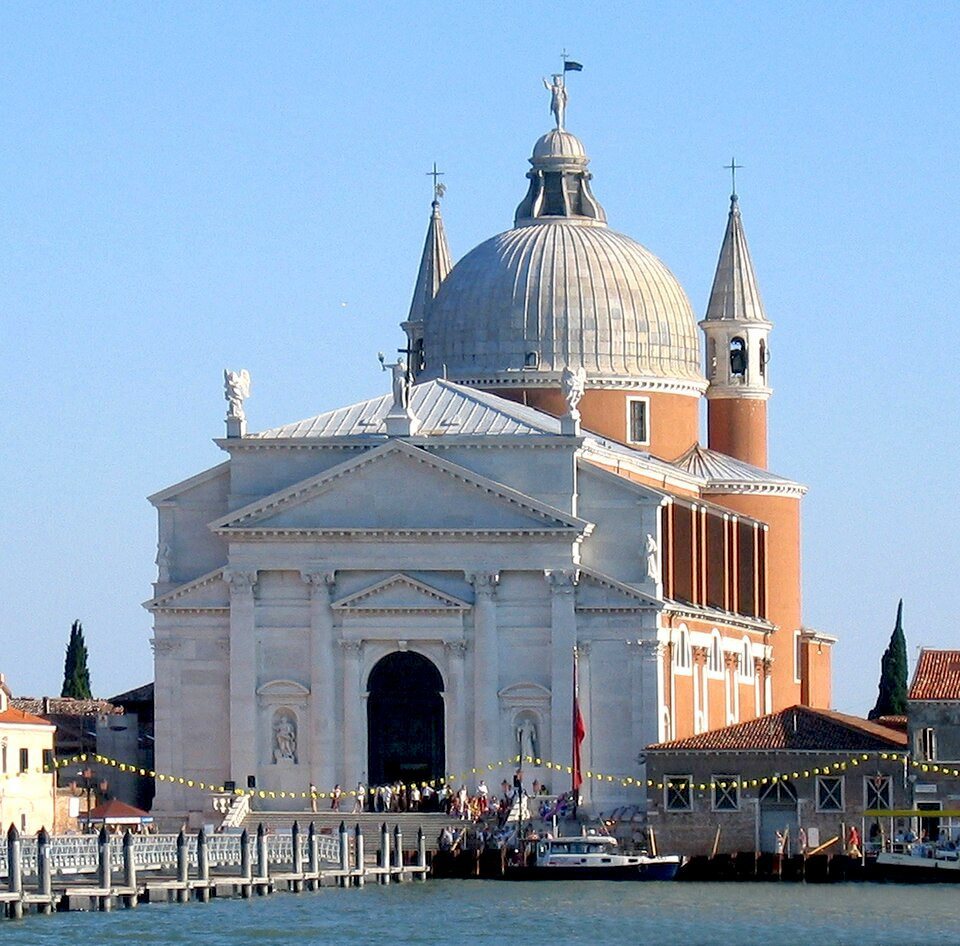
Il Redentore, Venice's vow against the plague
Built from 1577 to the designs of Andrea Palladio, the church of the Santissimo Redentore, on the island of the Giudecca, owes its existence to one of the most severe catastrophes in the history of Venice. The plague that appeared in 1575 claimed tens of thousands of victims in two years and carried off more than a third of the city's inhabitants. While the epidemic seemed impossible to contain, the Senate of the Republic decided, on 4 September 1576, to have a church dedicated to Christ the Redeemer built if the city was delivered from the scourge.
The project was entrusted to Palladio and the first stone was laid in May 1577. As early as the following 20 July, the end of the epidemic was celebrated with a great procession that crossed the Giudecca Canal on a bridge of boats to reach the sanctuary still under construction. The building work continued until 1586; after Palladio's death in 1580, Antonio da Ponte, also known for the reconstruction of the Rialto Bridge, completed the building, broadly respecting the architect's design.
One of Palladio's great religious masterpieces
The white facade facing the Giudecca Canal has become one of the characteristic landmarks of the southern front of Venice. Palladio superimposes and combines several forms inspired by the temples of Antiquity: pediments, columns and horizontal lines interlock to give a monumental unity to volumes of different heights. This composition is the culmination of research the architect had already undertaken on the facades of San Francesco della Vigna and San Giorgio Maggiore.
The interior seems almost austere in comparison. This bareness is not accidental: the church had been entrusted to the Capuchins, whose demands for simplicity directly influenced the design. Precious materials were limited in favour of brick, white plaster and terracotta, used even in some capitals. Palladio nonetheless transformed this economy of means into a particularly solemn architecture, dominated by light and large clear surfaces.
The plan is not truly a simple Latin cross. Palladio designed a succession of several spaces: a large rectangular nave, side chapels, a vast presbytery area under the dome, then the monks' choir. Each has its own proportions but gradually opens onto the next. This layout suited the Capuchin liturgy while creating a truly architectural staging that leads the eye to the high altar.
The church and especially its monumental sacristy also preserve an important collection of Venetian paintings. There are works by Paolo Veronese, Jacopo Tintoretto, Francesco Bassano and Palma il Giovane. Among the most remarkable pieces is the Baptism of Christ painted by Veronese around 1560, now kept in the sacristy, alongside paintings, reliquaries and devotional works from different periods.
Il Redentore is thus both a major monument by Palladio, a memorial to the 16th-century plague and the centre of a still living Venetian tradition. Its isolated position on the Giudecca quay further reinforces its monumental character: from the Zattere, its facade, dome and bell towers form one of the great architectural landmarks of the canal.
Visit: access to the church is free. The monumental sacristy of the Redentore, on the other hand, is accessible for a fee; the Chorus circuit currently indicates a full price of €3.50. Artistic visits are generally offered Monday to Saturday from 10:30 a.m. to 5 p.m. Hours, prices and openings may change, so it is best to verify them before your visit.
Sources and information
Chorus Venezia – Church of the Santissimo Redentore ; Palladio Museum – Church of the Redentore ; Comune di Venezia – Origins and history of the Festa del Redentore ; Venezia Unica – Giudecca and Redentore.
Map and route
Near the Church of the Redeemer and places in the district
On the island of Giudecca