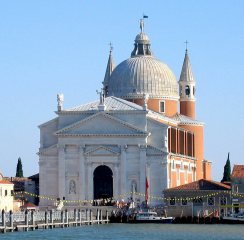
Saints Cosmas and Damian Complex Church
Former Benedictine convent and deconsecrated church on the Giudecca, later a hosiery factory and then an incubator for artisan workshops, with a 15th-century cloister and garden.
Saints Cosmas and Damian, monastic and industrial memory of the Giudecca
On the Campo San Cosmo, in the western part of the Giudecca, stands a vast complex formed by a former church, a Benedictine monastery and a 15th-century cloister. Deconsecrated as a religious establishment at the beginning of the 19th century, it successively had military, industrial, then cultural and artisan uses, whose transformations are still legible in its architecture.
The monastery was founded in 1481 on the initiative of Marina Celsi, a Benedictine patrician and nun, former abbess of San Maffio at Murano and then of Sant’Eufemia at Mazzorbo. With the authorization of Pope Sixtus IV and the support of the Venetian authorities, she created a community on the Giudecca committed to a more rigorous observance of the Benedictine rule. The complex was largely completed in 1492; the church and its campanile, absent from the famous view of Venice by Jacopo de’ Barbari in 1500, appear instead in an engraving published by Benedetto Bordone in 1528. The single-nave church with three apses was only consecrated in 1583.
Before its religious closure, the church had acquired remarkable artistic wealth. Its walls hosted works by Tintoretto, Palma il Giovane, Sebastiano Ricci, Giambattista Pittoni, and Giambattista Tiepolo, as well as an altarpiece by Giovanni Buonconsiglio made as early as 1497 for the first convent complex. The fall of the Republic and then the Napoleonic suppressions led to the dispersion of most of this heritage. Among the seized works are David Dancing before the Ark by Sebastiano Ricci and the Expulsion of the Merchants from the Temple by Angelo Trevisani, transferred to Milan and then installed in 1818 in the church of Somaglia, in Lombardy.
The nuns had been gathered at San Zaccaria as early as 1806 and the buildings were put to secular uses from 1810. In the 19th century, the former church served as a barracks, a hospital, and even a salt factory for livestock. At the end of the century, the installation of the Maglierie Herion further upset the building: two floors divided the nave into three levels, the frescoes were covered, and steam installations, pipes, lifts, and large vats were set up for textile production.
The restoration undertaken by the City of Venice from the 1990s onwards chose to preserve the traces of this history rather than artificially restore the church to its sole religious state. The work notably uncovered, beneath the plaster, significant painted decorations from the 16th and 17th centuries, including an Annunciation attributed to Francesco Salviati and the dome frescoes by Gerolamo Pellegrini. The cloister and its garden of approximately 4,000 m² were also recovered, while some industrial installations were preserved as witnesses to the monument’s second life.
The complex now hosts several cultural and artistic activities. The cloister notably houses artist studios of the Bevilacqua La Masa Foundation, while the Sala del Camino hosts exhibitions and events. The former convent also houses the Luigi Nono Archive Foundation, which preserves the documentary collection of the great Venetian composer.
Visit: Santi Cosma e Damiano is not a monument open at regular tourist hours. Some spaces become accessible during exhibitions, cultural events, or open studio days; it is therefore advisable to consult the programming of the Bevilacqua La Masa Foundation and the City of Venice.
Sources and additional information
Comune di Venezia – History of Santi Cosma e Damiano ; Comune di Venezia – restoration and uses of the complex ; Fondazione Archivio Luigi Nono ; Catalogo generale dei Beni Culturali – works from Santi Cosma e Damiano.
Map and route
Near the Saints Cosmas and Damian Complex and places in the district
On the island of Giudecca