Palazzo Grassi Palace
A great Grand Canal palace, now an exhibition venue of the Pinault Collection in Venice. Between the San Marco and Dorsoduro sestieri, the Palazzo Grassi is of interest beyond its art programme as a symbol of the shift from 18th-century patrician Venice to an international centre of contemporary art.
Palazzo Grassi, a classical palace turned contemporary art venue
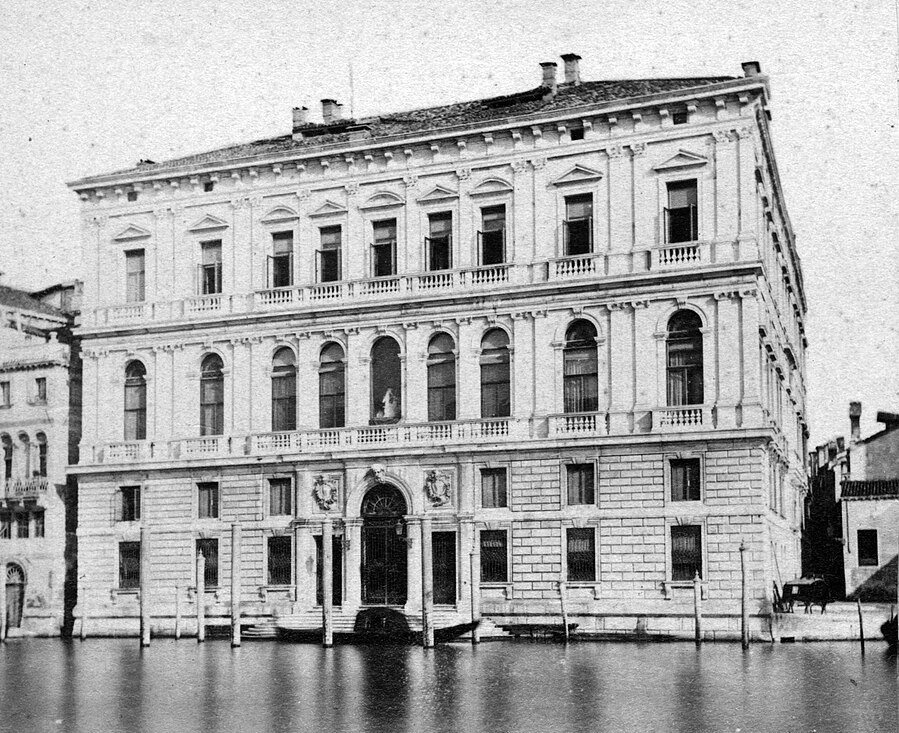
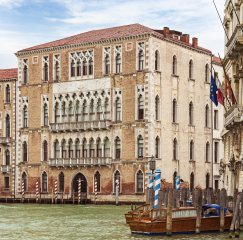
The Palazzo Grassi stands on the Grand Canal, near Campo San Samuele and Campo Santo Stefano. Its pale, regular and monumental façade contrasts with the Gothic and Renaissance palaces lining the canal: it belongs to an 18th-century Venice already turning towards a more classical architectural language.
The palace was built between 1748 and 1772 for the wealthy Grassi family, originally from Chioggia, who had acquired a large plot with a long frontage on the Grand Canal. The design is attributed to Giorgio Massari, one of the leading Venetian architects of the 18th century, also active at Ca' Rezzonico and in several of the city's major churches.
Its architecture reflects this late period. The Grand Canal façade abandons much of the decorative fantasy of earlier centuries in favour of a symmetrical composition, punctuated by windows and pilasters. Inside, however, the vast columned atrium, the grand staircase and the upper-floor rooms retain a far more theatrical decoration, enriched over the course of successive owners.
The palace changed hands several times in the 19th century. Baron Simeone de Sina in particular had certain spaces transformed and redecorated, leaving behind sumptuous painted ceilings. The interior thus allows visitors to read several eras at once: 18th-century Venetian architecture, 19th-century decoration and contemporary museum design.
From aristocratic residence to major exhibition venue
In the mid-20th century, the Palazzo Grassi's function changed profoundly. The Marinotti family installed the International Centre for Arts and Costume there, converting part of the palace to host exhibitions and cultural events. In 1983, Fiat in turn bought the building and entrusted Gae Aulenti, assisted by Antonio Foscari, with a major conversion for large-scale art and archaeology exhibitions.
François Pinault acquired the palace in 2005. The Japanese architect Tadao Ando then redesigned the spaces, largely respecting their historic architecture while adapting them to very different contemporary exhibitions. The Palazzo Grassi opened in 2006 as the first Venetian venue of the Pinault Collection.
The visit therefore depends heavily on the current temporary programme, but the building itself is a major part of the experience. The atrium, the grand decorated staircase, the frescoes and the historic ceilings all appear amid the contemporary works, sometimes creating striking confrontations across the centuries.
The Pinault Collection's Venetian presence later expanded to Punta della Dogana, opened in 2009 in the former maritime customs house at the tip of Dorsoduro, and then to the Teatrino next to the Palazzo Grassi. These venues offer very different architectural settings and allow both monographic exhibitions and large-scale shows to be presented.
On a route between San Marco and Dorsoduro, the Palazzo Grassi is thus an interesting stop even beyond its exhibition programme. On its own, it tells the story of the shift from an 18th-century patrician Venice to a city that has become one of the great international centres of contemporary art, without either identity ever fully erasing the other.
Sources and further information
Pinault Collection - Palazzo Grassi; Pinault Collection - The Pinault Collection in Venice; Palazzo Grassi - History of the palace.
Map and route
Near the Palazzo Grassi and places in the district
 Museum
Ca’ Rezzonico
85 m
Museum
Ca’ Rezzonico
85 m
 Palace
Ca' Foscari
128 m
Palace
Ca' Foscari
128 m
 Church
San Vidal Church
186 m
Church
San Vidal Church
186 m
 Square
Campo and church of Santo Stefano
194 m
Square
Campo and church of Santo Stefano
194 m
In the San Marco sestiere