Church of the Pietà Church
Church famous for its acoustics and its Tiepolo fresco, adjacent to the institution where Vivaldi taught.
The Church of the Pietà and the Venetian Musical Tradition
On the Riva degli Schiavoni, a few minutes from the Doge's Palace, the church of the Pietà, also called Santa Maria della Visitazione, is one of the most characteristic religious buildings of the 18th-century Venetian era. Built between 1745 and 1760 to the plans of Giorgio Massari, it combines architecture with classical lines and an interior designed for religious ceremonies but also for the important musical activity of the neighboring institution.
The interior is the most original part of the building. Its oval plan, rounded corners and large vault give the nave the appearance of a vast unified hall. Two choir galleries with wrought-iron grilles open along the side walls, while other gallery spaces occupy the area near the entrance. The female musicians of the Pietà could thus sing and play during services without being directly exposed to the public.
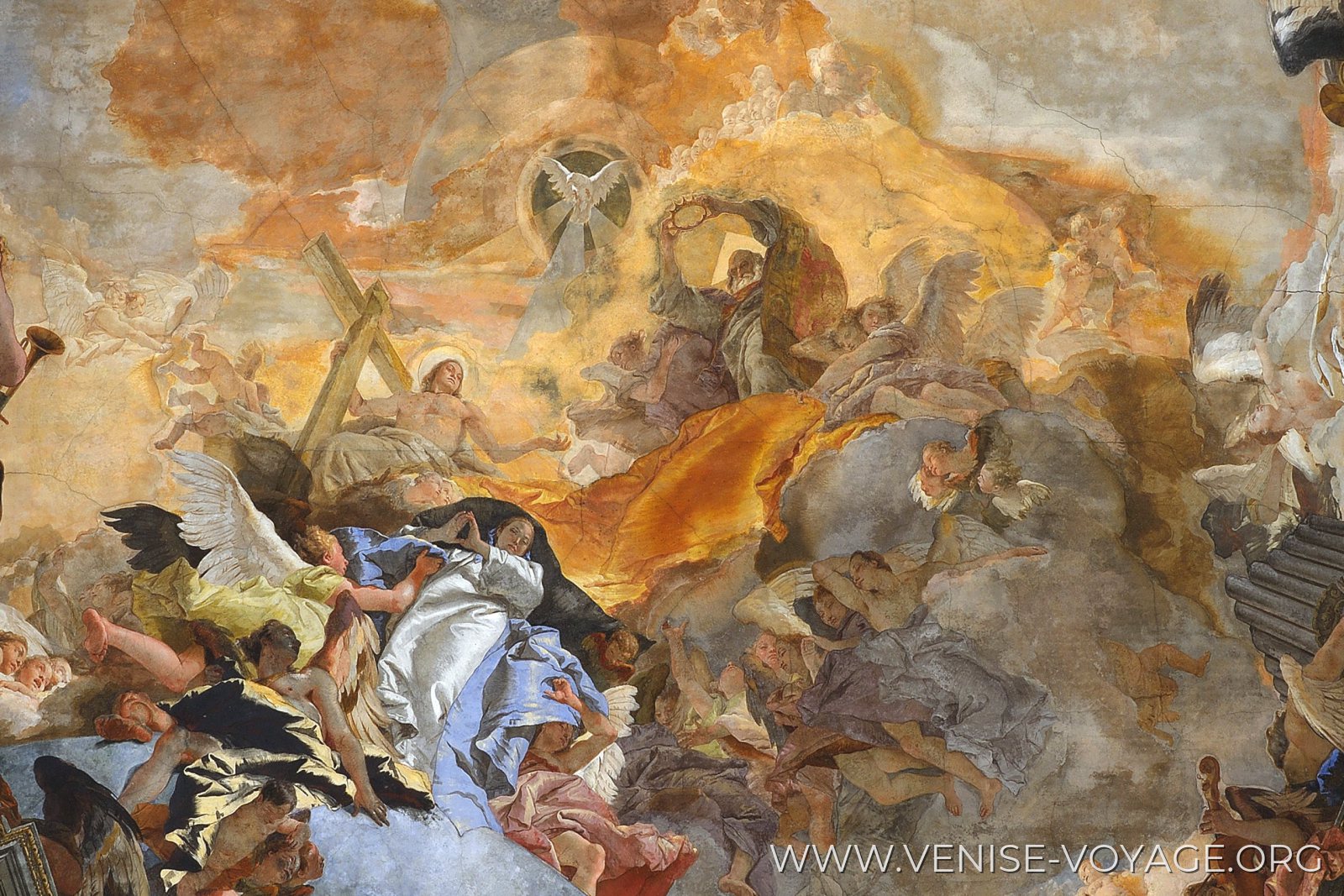
Coronation of the Virgin, detail
(Tiepolo, 1754)
The eye is especially drawn to the frescoes painted by Giambattista Tiepolo in 1754-1755, while the church was still under construction. The large composition on the vault depicts the Coronation of the Immaculate Virgin, carried toward heaven amid singing and music-making angels. Music is therefore not only linked to the church's use: it is directly integrated into its decoration. Other frescoes by Tiepolo complete this pictorial program.
The high altar also preserves several remarkable 18th-century elements. Its rich tabernacle is surrounded by gilded bronze figures, including the archangels Gabriel and Michael sculpted by Giovanni Maria Morlaiter. The altarpiece of the Visitation was begun by Giambattista Piazzetta, one of the great Venetian painters of his time.
Ospedale della Pietà and Vivaldi
This artistic wealth is inseparable from the Ospedale della Pietà, to which the church belonged. Founded in the 14th century to take in abandoned children, the Pietà gradually became one of the great musical teaching centers of Venice. The girls with the best aptitudes joined the figlie di coro and received demanding training. They sang but also played the violin, cello, flute, oboe, horn and sometimes much more unusual instruments. Their concerts attracted travelers from all over Europe and contributed greatly to the city's musical fame.
It was in this institution that Antonio Vivaldi was hired in 1703 as maestro di violino. With several interruptions, he worked for the Pietà until around 1740, teaching the young musicians and composing for them numerous vocal and instrumental works. The remarkable level of some boarders allowed him to write scores of great virtuosity.
On the side of the complex, another much more austere testimony of its history survives. An inscription dated 1548 recalls the religious sanctions incurred by parents who abandoned a child to the Pietà while they had the necessary resources to raise him or her. The text, linked to a decision by Pope Paul III, notably threatens excommunication for offenders until they have reimbursed the costs borne by the institution. It reminds us that the Pietà was first an important charitable institution before becoming famous throughout Europe for its musicians.
The musical tradition remains very present today. The church regularly hosts baroque music concerts, with an important place given to Vivaldi's works, notably the Four Seasons. These concerts therefore do not take place in the room where the composer historically worked, but in the 18th-century church that took up and perpetuated the musical vocation of the Pietà.
Visiting tips
The visit is worth considering as much for Massari's architecture and Tiepolo's frescoes as for the musical history of the place. In particular, you should look up at the large vault and observe the old galleries of the musicians. Concerts are regularly organized in the evening; as times, access conditions and programming may vary, it is best to check up-to-date information before your visit.
Sources and additional information
Istituto Santa Maria della Pietà - Chiesa della Pietà ; Chiesa della Pietà - history and musical tradition ; World Monuments Fund - Santa Maria della Visitazione ; Kimbell Art Museum - Tiepolo, The Coronation of the Virgin.
Map and route
Near the Church of the Pietà and places in the district
 Church
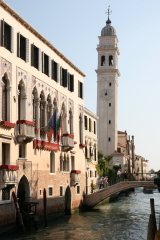
 of San Giorgio dei Greci
121 m
Church
Church of San Giorgio dei Greci
121 m
 Church
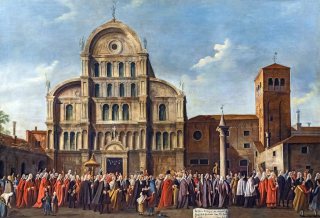
 of Saint Zachary
140 m
Church
Church of San Giovanni in Bragora
156 m
Church
Church of Saint Zachary
140 m
Church
Church of San Giovanni in Bragora
156 m
 Museum
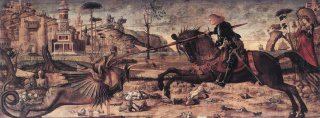
Scuola Dalmatà San Giorgio degli Schiavoni
259 m
Museum
Scuola Dalmatà San Giorgio degli Schiavoni
259 m
In the Castello sestiere