Church of San Giovanni in Bragora Church
Church where Antonio Vivaldi was baptized in 1678, known for its Baptism of Christ by Cima da Conegliano above the high altar.
San Giovanni in Bragora, the church of Vivaldi’s baptism
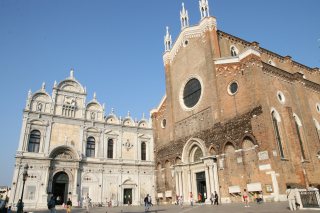
On the Campo Bandiera e Moro, a few steps from the Riva degli Schiavoni, the Church of San Giovanni in Bragora presents a sober brick facade characteristic of late Venetian Gothic. The current building mainly results from the reconstruction carried out between 1475 and 1505, but its origins are much older: tradition dates its foundation back to the 8th century, while the first known document attesting to its existence dates from 1090. A reconstruction is also recorded from 1178.
The great campaign of the late 15th century was favored by the pontificate of Pietro Barbo, who became pope under the name Paul II in 1464 and was born in this parish. The church kept its basilica plan with three naves, while the interior was later remodeled, especially between the late 16th and 18th centuries: the choir was removed, the presbytery transformed, and the high altar remade at the end of the 17th century.
The main masterpiece is the Baptism of Christ by Cima da Conegliano, painted around 1494 and still placed in the presbytery. It numbers among the oldest large Venetian altarpieces still preserved in their original location. The church also houses works by Alvise Vivarini, Bartolomeo Vivarini, and Palma the Younger. A chapel built in 1481 preserves the relics of Saint John the Almsgiver, patriarch of Alexandria, which arrived in Venice in the 13th century; its ancient decoration notably includes a Christ Blessing by Alvise Vivarini.
This connection places San Giovanni in Bragora among the main Vivaldi sites in Venice, along with the Ospedale della Pietà, where the future “red priest” taught violin and composed an important part of his work. The church remains, however, first and foremost a place of worship and a remarkable ensemble of religious art, less frequented than the great neighboring monuments of San Marco.
The origin of the name “Bragora” remains uncertain. Several hypotheses have been proposed, notably a link with an ancient market area or with the formerly humid and lagoon nature of the sector. Lacking a certain etymology, it is better to see it as the vestige of a very ancient toponym, prior to the densification of this part of Castello.
Sources and further information
Chorus Venezia - San Giovanni Battista in Bragora ; Save Venice - Baptismal fonts of San Giovanni in Bragora ; Chorus Venezia - Chapel of Saint John the Almsgiver ; San Giovanni Battista in Bragora - church website.
Map and route
Near the Church of San Giovanni in Bragora and places in the district
 Church
 of the Pietà
156 m
Church
Church of the Pietà
156 m
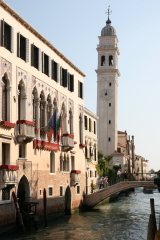 Church
 of San Giorgio dei Greci
197 m
Church
Church of San Giorgio dei Greci
197 m
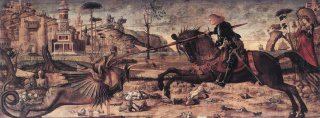 Museum
Scuola Dalmatà San Giorgio degli Schiavoni
226 m
Museum
Scuola Dalmatà San Giorgio degli Schiavoni
226 m
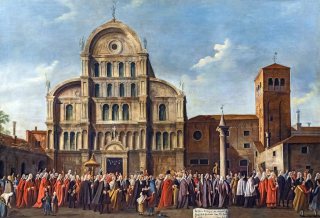 Church
 of Saint Zachary
283 m
Church
Church of Saint Zachary
283 m
In the Castello sestiere