Church of San Giorgio dei Greci Church
Greek Orthodox church with a noticeably leaning bell tower, seat of the Orthodox Archdiocese of Italy and Malta, with its neighbouring icon museum.
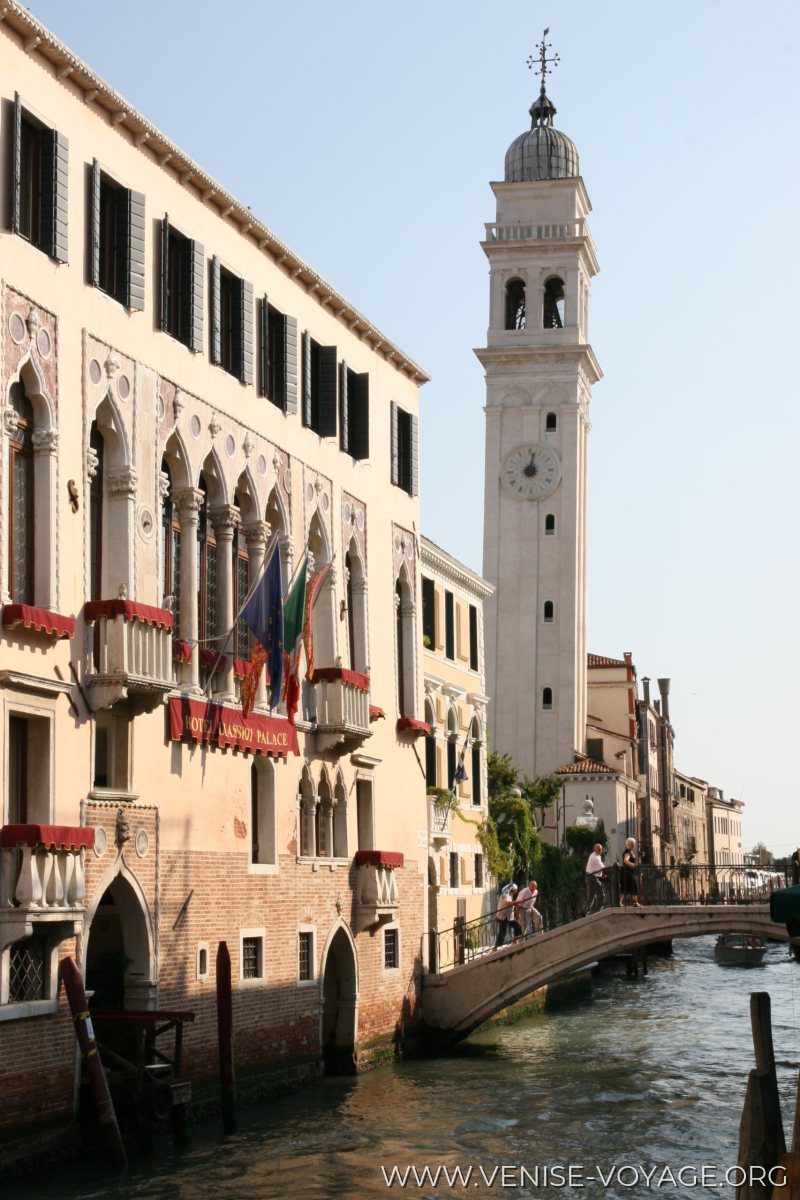
San Giorgio dei Greci, the Orthodox church with the leaning campanile


Campanile of
San Giorgio dei Greci
Along the Rio dei Greci, in the sestiere of Castello, the San Giorgio dei Greci church is the main monumental testament to the ancient Greek Orthodox community of Venice. Present in the city since the Middle Ages, it grew significantly after the fall of Constantinople in 1453, with the arrival of refugees, merchants, and scholars from the Greek world. After decades of approaches to the Venetian and papal authorities, the community was finally able to build its own sanctuary. The works extended from 1536 to 1577 under the direction of Sante Lombardo and then Zuanantonio Chiona; Andrea Palladio also intervened for the part of the church reserved for women.
Today the cathedral church of the Orthodox Archdiocese of Italy and the Exarchate for Southern Europe, San Giorgio dei Greci retains a decor that affirms its Byzantine identity in a city of Latin Catholic tradition. The iconostasis and the numerous icons count among the major elements of the visit. Some were brought by refugees from Constantinople; others are due to renowned Greek painters, notably Michele Damaskinos, Emmanuel Tzanès, and Thomas Bathas. The decoration of the dome was entrusted to Giovanni di Cipro under the supervision of Tintoretto, with the requirement to respect the maniera greca, the Greek iconographic tradition.
The Campo dei Greci forms a particularly cohesive Greek cultural ensemble around the church. The former Flanginian College, founded in the 17th century to educate young Greeks, now houses the Hellenic Institute of Byzantine and Post-Byzantine Studies. The Icon Museum, on the other hand, occupies the neighbouring Scoletta di San Nicolò, the former seat of the confraternity and its hospital. It preserves Byzantine and post-Byzantine works, as well as manuscripts, documents, and liturgical objects linked to the history of the Greeks of Venice.
Obtaining a dedicated sanctuary was a long process. As early as 1410, the Greeks were able to celebrate their rite in the Catholic church of San Biagio, but their situation remained precarious: an authorization granted in 1456 to build an Orthodox church was revoked the following year. In 1498, they obtained recognition of their confraternity, the Scuola di San Nicolò dei Greci, then in 1514 the authorization to acquire land to build a church dedicated to Saint George. San Giorgio dei Greci thus appears as the culmination of more than a century of negotiations and one of the main symbols of the Greek presence in Venice.
Sources and further information
Hellenic Institute of Byzantine and Post-Byzantine Studies - church and historic monuments ; Hellenic Institute - history of the Greek community of Venice ; Hellenic Institute - Icon Museum ; Orthodox Archdiocese of Italy - San Giorgio dei Greci.
Map and route
Near the Church of San Giorgio dei Greci and places in the district
 Church
 of the Pietà
121 m
Church
Church of the Pietà
121 m
 Church
 of Saint Zachary
125 m
Church
Church of Saint Zachary
125 m
 Museum
Scuola Dalmatà San Giorgio degli Schiavoni
164 m
Church
Church of San Giovanni in Bragora
197 m
Museum
Scuola Dalmatà San Giorgio degli Schiavoni
164 m
Church
Church of San Giovanni in Bragora
197 m
In the Castello sestiere