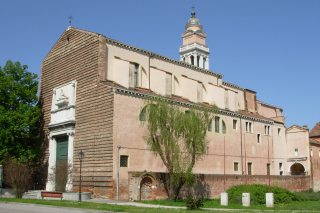
Almost deserted today, Torcello was one of the very first settlements of the lagoon, more populated than Venice itself in the early Middle Ages. It preserves the oldest cathedral in the lagoon and its Byzantine mosaics.
Torcello, one of the cradles of the lagoon
A short crossing from Burano, Torcello now has only a tiny population, scattered in a landscape of meadows, gardens, canals and reed beds. This silence is surprising when one discovers that before the rise of Venice, the island was one of the main political, religious and commercial centers of the northern lagoon.
Traces of occupation exist since antiquity, but settlement intensified especially in the 6th and 7th centuries, when populations from the mainland, particularly from the Altino region, sought greater safety in the lagoon. Torcello gradually became an important relay between the continent, the islands and the Adriatic.
This contrast explains much of Torcello's interest: a few monuments of exceptional importance now stand in the middle of an almost rural landscape. The central square alone brings together the cathedral, Santa Fosca and the two museum palaces, like surviving fragments of a city that has become largely invisible.
Places to discover in Torcello
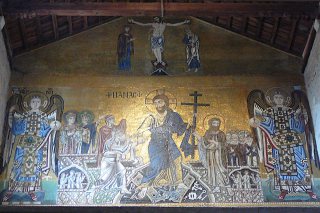
- The Santa Maria Assunta Cathedral: founded in 639 and largely rebuilt in 1008, it is the essential monument of Torcello. It preserves remarkable medieval mosaics of Byzantine tradition, including the Virgin in the apse and the immense Last Judgment covering the western wall. Its campanile dominates the whole island and, by its very dimensions, recalls the importance of the ancient city.
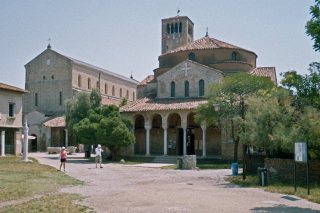
- The Santa Fosca Church: immediate neighbor of the cathedral, this 11th-century church has a central cross plan surrounded by an elegant portico with arcades arranged in an octagonal shape. More austere than Santa Maria Assunta, it forms with it one of the most remarkable medieval religious complexes in the lagoon.
- The Torcello Museum: housed in the Archives Palace and the Council Palace, it brings together an archaeological section and a medieval and modern collection. Ancient remains, sculptures, mosaic fragments, inscriptions and objects from Torcello and the lagoon help us understand what the still-standing monuments no longer show: the extent and richness of the ancient settlement.
- Torcello vanished, remains and curiosities of the ancient city: beyond the great monuments still standing, several traces allow us to imagine the medieval city now almost entirely erased. The Devil's Bridge, a rare ancient Venetian bridge without parapet and surrounded by legends, is one of its most famous curiosities. Around the center also remain the ruins of the cathedral's baptistery and the ancient monastery of San Giovanni Evangelista, while the famous “Throne of Attila” recalls how much history and legend are intertwined at Torcello. These scattered fragments give an idea of the extent of a city once much larger than the small monumental core visible today.
The walk from the landing stage is itself part of the visit. The path runs along the Torcello canal, crosses the bridges and passes through a landscape where the built space quickly gives way to meadows and wetlands. After the density of Venice or the tight facades of Burano, this slow approach prepares us quite well for what is most singular about Torcello: an ancient city whose streets must now be imagined among the monuments that have survived.
Sources and additional information
Venezia Unica – Torcello ; Museo di Torcello – MUVE ; Comune di Venezia – Burano, Mazzorbo and Torcello ; World Monuments Fund – Basilica Santa Maria Assunta.
Places in Torcello
4 places in this district.
 1
Church
Cathedral of Santa Maria Assunta
Founded in 639, the oldest church in the lagoon retains exceptional Byzantine mosaics.
1
Church
Cathedral of Santa Maria Assunta
Founded in 639, the oldest church in the lagoon retains exceptional Byzantine mosaics.
 2
Church
Church of Santa Fosca
Romanesque-Byzantine church of octagonal plan, adjacent to the cathedral of Torcello.
2
Church
Church of Santa Fosca
Romanesque-Byzantine church of octagonal plan, adjacent to the cathedral of Torcello.
 3
Museum
Torcello Museum
Spread across two medieval palaces, it preserves the archaeological remains of the island's prestigious past.
4
Street / Area
Vanished Torcello
Beyond its great monuments, Torcello preserves the traces of a city that was once far larger. A bridge without parapets, religious…
3
Museum
Torcello Museum
Spread across two medieval palaces, it preserves the archaeological remains of the island's prestigious past.
4
Street / Area
Vanished Torcello
Beyond its great monuments, Torcello preserves the traces of a city that was once far larger. A bridge without parapets, religious…
Sur le même thème