Church of Santa Fosca Church
Romanesque-Byzantine church of octagonal plan, adjacent to the cathedral of Torcello.
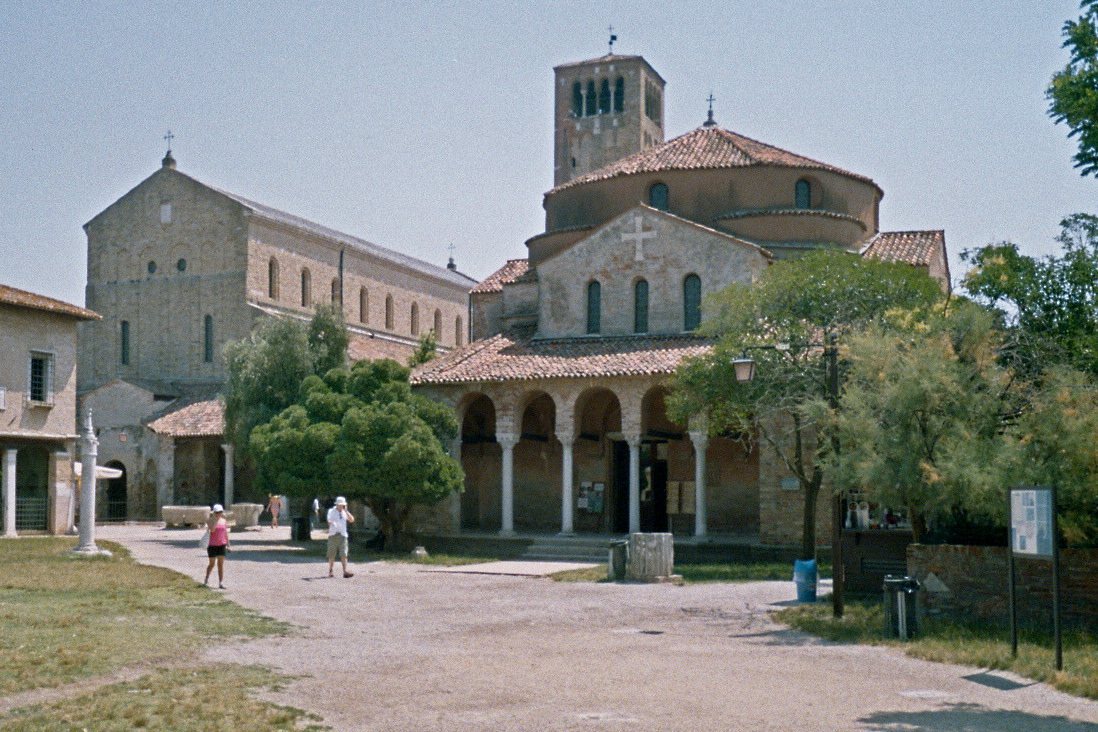
Santa Fosca, the Byzantine octagon of Torcello
A few meters from the Santa Maria Assunta cathedral, the Church of Santa Fosca forms, together with it, the heart of Torcello's ancient religious complex. Its exact dating remains debated: a church dedicated to the saint is attested with certainty in 1011 by a deed of donation, while the building visible today is generally attributed to the 11th and 12th centuries. Its architecture bears witness to the particularly close relations that the Venetian lagoon then maintained with the Byzantine world.
The plan is more complex than a simple octagon: the church adopts a Greek cross organized around a central space. Eight marble columns arranged in an octagonal shape support the arches that ensure the transition to the circular drum of the roof, about ten meters wide. This solution, exceptional in medieval Italy, has close similarities with the middle Byzantine churches of Greece, particularly those of Hosios Loukas and Daphni.
Outside, an elegant arcaded portico wraps around part of the building and visually links it to the neighboring cathedral. The arches rest on slender columns with carved capitals, while the apse features brick decoration composed of blind arcades and geometric patterns. Some of these elements find parallels in Eastern Byzantine architecture but also, in the lagoon, at the basilica of Santi Maria e Donato in Murano.
The interior is today much more austere than that of Santa Maria Assunta. Its interest lies mainly in the readability of its structure: from the square space at the base, the eye follows the eight supports, then the transition to the octagon, before reaching the circular drum. This almost geometric architecture makes Santa Fosca one of the most singular testimonies of Byzantine influence in the Venice lagoon.
Visit: Santa Fosca is immediately next to the cathedral and can naturally be discovered during the same visit to the monumental complex. Access conditions and opening hours may change, so it is best to check them before going.
Sources and additional information
Museo di Torcello – Città metropolitana di Venezia, for the official description of the plan and architecture; Venezia Unica – Torcello, for the context of the monumental complex and the Martyrium; A. Manzo, Santa Fosca in Torcello and the Middle Byzantine Churches in Eastern Mediterranean, a study devoted to the dating, the octagonal structure, and the comparisons with Greek middle Byzantine architecture.
Map and route
Near the Church of Santa Fosca and places in the district
 Church
Cathedral of Santa Maria Assunta
56 m
Street / Area
Vanished Torcello
245 m
Church
Cathedral of Santa Maria Assunta
56 m
Street / Area
Vanished Torcello
245 m
On the island of Torcello

Nearby places to stay
Sur le même thème