Church of San Nicolò da Tolentino Church
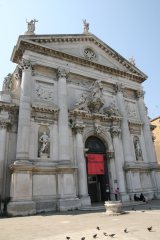
Large church near Piazzale Roma, recognizable by its classical portico and its connection with the Tolentini. It shows that Santa Croce is not just an entry point. Even before reaching its quieter areas, the visitor encounters here a major complex where religious architecture, convent heritage, and contemporary creation intersect.
The Tolentini, Monumental Entrance to Santa Croce
The Church of San Nicolò da Tolentino, commonly called the Tolentini, is located near Piazzale Roma, in the western part of Santa Croce. Its position makes it one of the first monuments encountered when arriving in Venice, but also one that travelers rushing to the center rarely take the time to observe.
Construction of the current building began in 1591 under the direction of Vincenzo Scamozzi, one of the leading Venetian architects of the late Renaissance. The church adopts a vast single-nave plan, flanked by side chapels and extended by a deep presbytery. Its ample and regular proportions reflect the search for clarity characteristic of Counter-Reformation religious architecture.
A Classical Portico in the Venetian Landscape
The most spectacular element remains the great portico with Corinthian columns, added in the early 18th century by Andrea Tirali. Inspired by the architecture of ancient temples, it replaces the traditional expected facade and gives the church an almost Roman silhouette, particularly unusual on the edge of a Venetian canal.
Inside, the eye is drawn to the richly decorated coffered ceiling, the large altars, and several funerary monuments. The ensemble also preserves paintings and sculptures from the 17th and 18th centuries, which testify to the importance acquired by the church and its religious order in Baroque Venice.
The former neighboring convent now serves as the historic headquarters of the IUAV University of Venice, specializing in architecture, urban planning, and design. The complex houses the university's administrative offices and its library. Its entrance courtyard was redesigned in the 20th century by the architect Carlo Scarpa, who introduced a modern composition attentive to materials, water, and pathways.
Interior visits depend on periods and opening hours. From the campo, however, it remains possible to appreciate the monumental portico, the relationships between the church, the former convent, and the canals, as well as the contrast between classical architecture and the constant activity of the nearby access points.
Sources and Additional Information
Università IUAV di Venezia – Tolentini ; Università IUAV di Venezia – sedi ; Venezia Unica – Santa Croce.
Map and route
Near the Church of San Nicolò da Tolentino and places in the district
 Church
San Rocco Church
274 m
Church
San Rocco Church
274 m
 Museum
Scuola Grande di San Rocco
290 m
Museum
Scuola Grande di San Rocco
290 m
In the Santa Croce sestiere