A peaceful fishing village in the south of the Lido, Malamocco was once the seat of ducal power before the rise of Venice around the Rialto. Today it retains quiet alleys very different from the bustle of the rest of the island.
Malamocco, the forgotten ancient capital
In the southern part of the Lido of Venice, far from the grand hotels and the bustle of the beaches, Malamocco is a small lagoon village of low houses, alleys, squares and canals. Its peaceful atmosphere contrasts with the historical importance of the place: long before Venice became centered around Rialto and St. Mark's, this part of the lagoon hosted the seat of ducal power for a few decades.
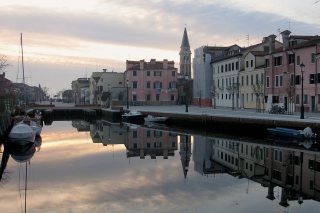
The current village retains a physiognomy almost independent from the rest of the Lido. A few bridges cross the canals bordering the ancient core, while the moored boats, modest facades and small squares sometimes give the impression of a Venice reduced to the scale of a village. Malamocco was, along with San Nicolò, one of the main ancient centers of the Lido.
The history of ancient Metamauco remains partly difficult to reconstruct. An old tradition reports that a violent marine catastrophe, generally dated around 1106-1107, destroyed or submerged a large part of the original settlement. The medieval village then developed on the site of present-day Malamocco. The image of a real "sunken city" under the waters off the Lido is appealing and deeply rooted in local stories, but the exact location and extent of the ancient city remain debated.
Malamocco went through other trials, notably in 1379 during the War of Chioggia, when the Genoese occupied and damaged the area. Despite these disruptions, the village retained a certain administrative importance. The Palace of the Podestà, built in the 15th century and overlooking the church square, recalls this function: it was later used as the municipal seat and houses archaeological objects and remains from the surrounding territory, among others.
Between a little Venice and great lagoon history
The heart of the village is organized around the Campo della Chiesa and the church of Santa Maria Assunta. The alleys and small bridges around it create a landscape very different from the seaside Lido developed in the 19th and 20th centuries. Here, it is above all the history of the lagoon, the old fishing communities and the water-borne circulations that give the place its character.
What to see in Malamocco
- The old village: it is best explored without too rigid an itinerary. Narrow alleys, small canals, bridges and colorful houses form a very compact whole, much closer in its organization to the historic villages of the lagoon than to the modern districts of the Lido.
- The church of Santa Maria Assunta: the main church of Malamocco, it houses works from different periods as well as two objects particularly linked to local traditions: the Christ from Poveglia and the statue of the Madonna di Marina, still at the center of an important popular festival.
- The Palace of the Podestà: this 15th-century building, also called Palazzo Pretorio, recalls the village's old administrative organization. Archaeological discoveries made in the area testify to the site's long occupation.
- The Malamocco inlet (Bocca di Malamocco): located further south, between the Lido and Pellestrina, it is one of the three main passages between the lagoon and the Adriatic. With a depth of about 14 meters, it is the deepest of the three inlets and the main route used by large ships heading to the commercial and industrial port of Marghera.
The proximity of the inlet gives the area a rather singular contrast. A few kilometers from the silence of Malamocco's canals, large ships pass by on their way to Marghera. The inlet also hosts one of the three barriers of the MOSE, with a lock designed to maintain navigation when the mobile structures protect the lagoon from high waters.
Malamocco is easily reached by bus or bike from the center of the Lido. As you go south, the large buildings and seaside atmosphere gradually give way to gardens, low houses and a less urban landscape. This slow arrival suits Malamocco particularly well: you come less to accumulate monuments than to discover one of the few places where the origins of Venice remain perceptible in the very scale of the landscape.
Places in Malamocco and Alberoni
4 places in this district.
 1
Street / Area
Old Town of Malamocco
Ancient heart of the village, alleyways, canals and small bridges away from the seaside bustle of the Lido.
1
Street / Area
Old Town of Malamocco
Ancient heart of the village, alleyways, canals and small bridges away from the seaside bustle of the Lido.
 2
Other
Alberoni and Malamocco Pass
One of the three passes connecting the lagoon to the Adriatic, the deepest of the three, used by large ships to reach Marghera.
3
Church
Church of Santa Maria Assunta
The main church of Malamocco, it preserves the venerated statue of the Madonna di Marina and a Christ from Poveglia.
4
Palace
Palace of the Podestà
15th-century building overlooking the church square, former administrative seat now a small local museum.
2
Other
Alberoni and Malamocco Pass
One of the three passes connecting the lagoon to the Adriatic, the deepest of the three, used by large ships to reach Marghera.
3
Church
Church of Santa Maria Assunta
The main church of Malamocco, it preserves the venerated statue of the Madonna di Marina and a Christ from Poveglia.
4
Palace
Palace of the Podestà
15th-century building overlooking the church square, former administrative seat now a small local museum.