Santa Maria degli Angeli Church Church
Ancient 12th-century conventual church in the west of Murano, which welcomed some of Venice's greatest noble families before becoming a parish church.
Santa Maria degli Angeli, an ancient patrician convent in Murano
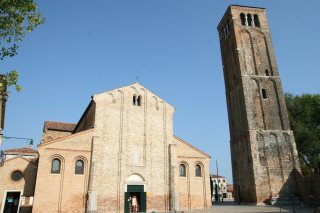
On the Fondamenta Sebastiano Venier, at the western end of Murano, the church of Santa Maria degli Angeli occupies the site of an ancient Augustinian monastery whose origins date back to the late 12th century.
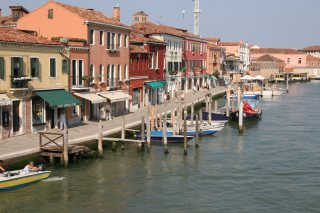
Set apart from the most frequented paths around the Glass Museum and San Pietro Martire, Santa Maria degli Angeli also reveals another side of Murano. The Canal degli Angeli, the gardens and the quiet banks surrounding the church give this western part of the island a distinctly more peaceful atmosphere.
A convent sought after by the Venetian patriciate
In 1187, the noblewoman Ginevra Gradenigo ceded a plot of land bordered by water to Giacomina Boncio to establish a religious community; authorization to build the church and monastery was granted the following year by the Bishop of Torcello.
Rebuilt and enlarged between the late 15th and early 16th century, the church was consecrated in 1529. The monastery, united with that of Santa Maria di Piave at Lovadina, then acquired considerable wealth and prestige. In particular, it welcomed nuns from Venice's great patrician families, who contributed to enriching the church with works of art and decorations.
Suppression of the convent and restoration of the church
The monastery was suppressed in 1810 during the Napoleonic reforms, then demolished in 1832. A significant part of its artistic heritage was dispersed or transferred to other churches on Murano. Threatened with ruin and closed in 1848, the church was restored from 1861 and solemnly reopened for worship on 12 July 1863. It remains a place of worship on Murano, entrusted to a rector, but is no longer an autonomous parish.
What can be seen there
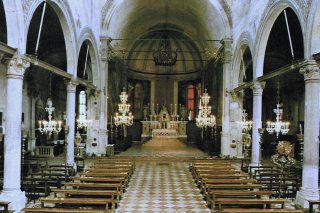
Behind a relatively sober façade, the interior still preserves a notable artistic heritage. The high altar is dominated by the Annunciation painted around 1537 by Il Pordenone; there are also works by Palma il Giovane, Francesco Zugno and Antonio Molinari. The entrance itself is adorned with a relief of the Annunciation in Istrian stone.
Sources and further information
- Catalogo generale dei Beni Culturali — Chiesa di Santa Maria degli Angeli — official heritage record.
- Patriarchate of Venice — Santa Maria degli Angeli — current ecclesiastical status.
- Vincenzo Zanetti, Del monastero e della chiesa di Santa Maria degli Angeli di Murano (1863) — historical source.
Map and route
On the island of Murano