
San Michele Island
The first island one encounters when leaving Venice northwards, San Michele has been the city's cemetery since the early 19th century, surrounded by high brick walls and planted with cypresses. It combines in a compact space monastic architecture, the church, funerary memory, and contemporary interventions.
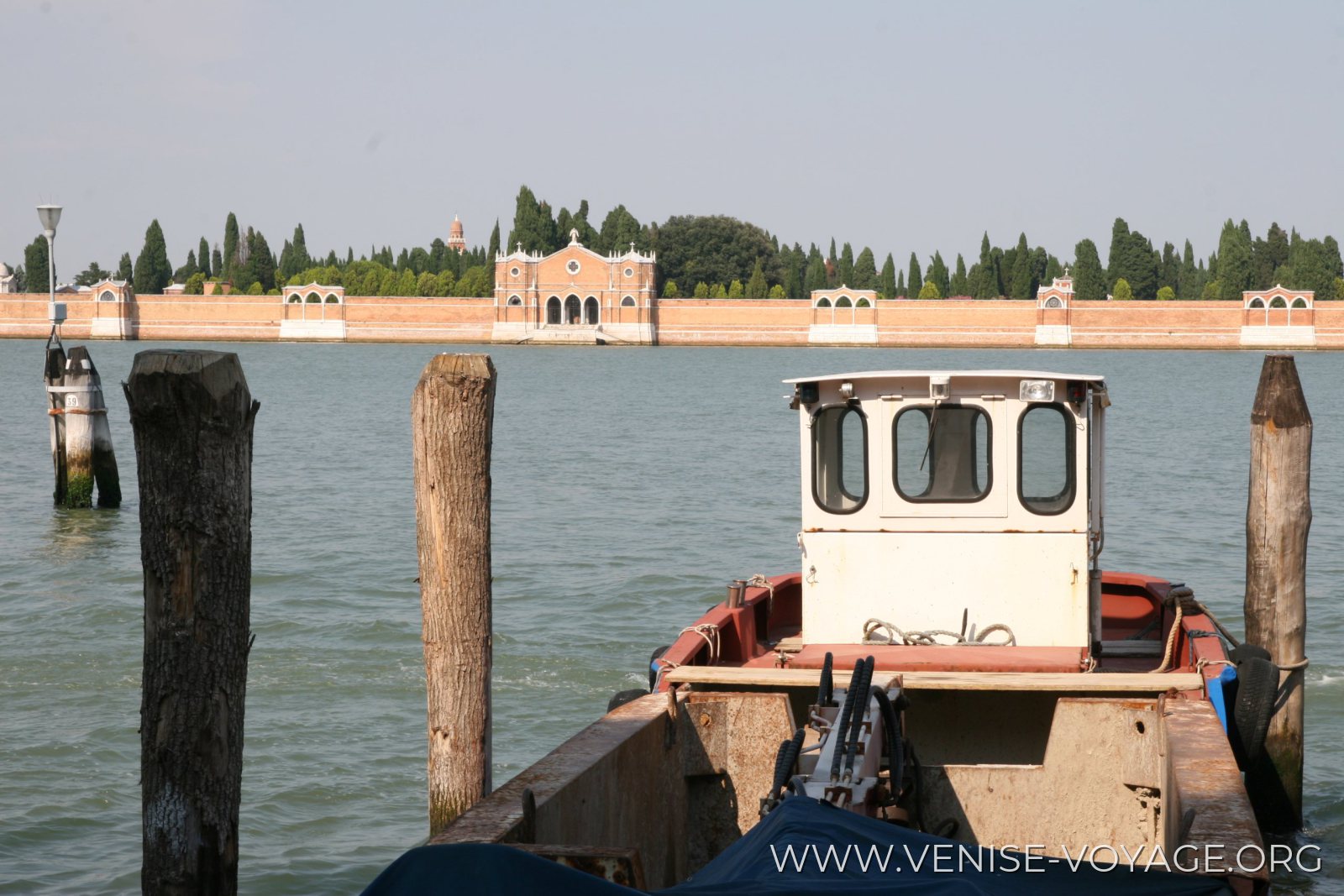
San Michele, Venice's island cemetery
Located in the northern lagoon, a few hundred meters from the Fondamente Nove and on the way to Murano, San Michele forms a rectangle of brick walls and cypresses visible from the vaporetto. For over two centuries, it is here, rather than in the central parishes, that Venice buries its dead.
Access is by vaporetto, with a dedicated stop called "Cimitero". The visit, free of charge, allows you to discover a cemetery organized into confessional sections, including Catholic, Greek Orthodox, and Evangelical, reflecting the diversity of those who have chosen or received Venice as their final resting place.
The insular nature of the cemetery long imposed a particular ritual: coffins were transported by boat, formerly even in funeral gondolas, some of which were richly ornamented. This relationship between the city, water, and the dead remains one of San Michele's strongest singularities.
In the 20th century, the island hosts the graves of several artistic figures who lived or stayed in Venice, contributing to its fame far beyond its sole funerary function.
Besides Stravinsky and Diaghilev, who are found further in the Orthodox section, San Michele notably shelters the burials of American poet Ezra Pound and poet Joseph Brodsky. These famous graves, however, should not make one forget that the island remains above all the cemetery for generations of Venetians.
Island of San Michele viewed from Cannaregio
Places to discover in San Michele
San Michele in Isola, Venice's first Renaissance
Built from 1469 by ,. Its facade in Istrian stone,
Designed by architect Mauro Codussi and his collaborators between 1468 and 1477, the church of San Michele in Isola constitutes one of the earliest and clearest manifestations of Renaissance architecture in Venice. The facade with its classical and harmonious lines clearly contrasted with the still-dominant Gothic in the city at the time. It arranges with great sobriety arches, pilasters, pediments, and circular forms, heralding a language that would soon take a major place in Venetian architecture.
The church predates the creation of the cemetery by several centuries: it originally belonged to a Camaldolese convent, before the island became, in the 19th century, the official cemetery of Venice.
The Camaldolese settled on the island as early as 1212. The complex also preserves a brick campanile built in 1456 and the Emiliani Chapel, constructed in the 16th century to a design by Guglielmo dei Grigi: several centuries of religious architecture are thus gathered around the church.
The cloister of San Michele
Adjacent to the church of San Michele in Isola, the cloister of the convent preserves the peaceful atmosphere inherited from its original religious vocation, before the former monastic island was gradually integrated into the cemetery during the 19th century.
Passing through the cloister, before reaching the cemetery proper, offers a calm transition between the Renaissance monument and the vast funerary field that extends beyond.
The Orthodox and Protestant section of San Michele cemetery
San Michele cemetery is organized into distinct confessional sections, including Catholic, Greek Orthodox, Evangelical, and Jewish, reflecting the diversity of those who have chosen or received Venice as their final resting place over the course of the 19th and 20th centuries.
Visiting these quarters allows one to measure how Venice, a cosmopolitan city for centuries, has continued to attract artists and intellectuals from all over Europe to their final rest.
The contemporary extensions of San Michele cemetery
Faced with the progressive saturation of the island, San Michele cemetery has acquired new sections over the course of the 20th and 21st centuries, including a notable extension designed by British architect David Chipperfield. Originating from an international competition launched in 1998, his project abandoned the simple succession of funerary rows in favor of enclosed courtyards and austere volumes inspired, without imitating, by the ancient cloisters, blending concrete walls and contemporary columbariums.
The Court of the Four Evangelists was inaugurated in 2007; a second phase, completed in 2017, notably includes the Court of the Three Archangels and a new ossuary.
These contemporary extensions deliberately contrast with the historic architecture of the island's entrance, illustrating how Venice continues to adapt its main cemetery to the needs of a still-inhabited city.
Sources and further information
Comune di Venezia - Cimitero di San Michele ; Comune di Venezia - History of San Michele cemetery ; Comune di Venezia - Confessional sections of San Michele ; David Chipperfield Architects - Extension of San Michele cemetery ; Venezia Unica - San Michele and the northern lagoon.