
San Lazzaro degli Armeni Island
Since 1717, this small island has been home to a Mekhitarist Armenian monastery with a rich library and a polyglot printing press, where Lord Byron notably stayed to study Armenian.
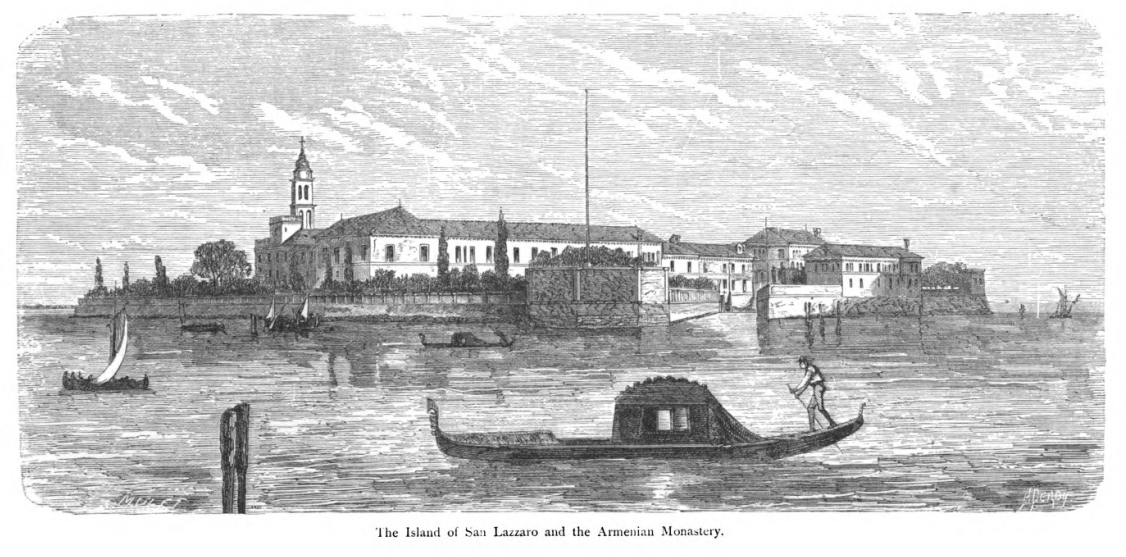
San Lazzaro degli Armeni, an Armenian island in the Venice lagoon
Between the historic center of Venice and the Lido, the small island of San Lazzaro degli Armeni has been, for more than three centuries, a true center of Armenian culture in the middle of the lagoon. Almost entirely occupied by its monastery, it has housed since 1717 the Mekhitarist monks, an Armenian Catholic congregation whose work on language, history, publishing, and manuscripts has largely exceeded the limits of the island.
San Lazzaro had, however, known several lives before. Its isolation particularly led it to host a leper colony in the Middle Ages, the probable origin of its name, Saint Lazarus being traditionally associated with lepers. After various religious occupations and a period of abandonment, the island definitively took on its current identity at the beginning of the 18th century.
In the 18th and 19th centuries, San Lazzaro became one of the main intellectual centers of the Armenian diaspora. The Mekhitarists collected ancient manuscripts, edited historical texts, composed dictionaries and scholarly works, translated European authors, and distributed their publications as far as the Near East and Asia. This activity explains the astonishing cultural density of an island that could be crossed on foot in a few minutes.
Even today, the island remains a living monastery, not an ordinary museum. The discovery takes place within a guided tour, which gives access to part of the religious spaces and collections. Above all, it shows how a single place was able to bring together for three centuries monastic life, philological research, publishing, heritage conservation, and exchanges between Armenia and Europe.
San Lazzaro degli Armeni thus stands out from the other islands of the lagoon. One comes here to discover an exceptionally preserved center of Armenian memory and transmission. In just a few rooms, the visit takes you from monasticism to printing, from medieval manuscripts to ancient Egypt, and from Mekhitar to Byron.
Places to discover at San Lazzaro degli Armeni
The library and printing house of San Lazzaro degli Armeni
The Mekhitarist monastery of San Lazzaro houses one of the world's most important Armenian manuscript libraries, assembled since the congregation's arrival on the island in 1717. A polyglot printing press, active since the end of the 18th century, still publishes works in many languages today.
It brings together tens of thousands of works in Armenian, but also in many European and Eastern languages. The monastery preserves more than 4,000 illuminated manuscripts and codices, some dating back to the early Middle Ages, constituting the largest collection of Armenian manuscripts kept in the West. Religious texts, chronicles, literary, scientific, or philosophical works testify to the essential role played by the monks in safeguarding and studying Armenian culture.
The printing press, one of the oldest in Europe still partly active in its field, has published over the centuries works in dozens of languages, helping to spread Armenian culture far beyond its diaspora. Publishing was one of the major instruments of the Mekhitarist work. After first working with Venetian printers, the community developed its own printing press at the end of the 18th century. It published grammars, dictionaries, translations, religious, historical, and literary works intended for Armenian communities scattered between Europe and the East. San Lazzaro thus became an essential link in a particularly ancient Armenian printing tradition in Venice, where the first book printed in Armenian had already appeared in 1512.
The museum of the monastery of San Lazzaro
The monastery museum brings together eclectic collections, reflecting the travels and relationships woven by the Mekhitarist congregation over the centuries: Armenian religious art, Far Eastern objects, and Egyptian antiquities are among the pieces preserved.
Archaeological objects, oriental arts, paintings, and gifts received by the congregation tell the story of the monastery's international networks.
This diversity, unusual for a monastery, illustrates the intellectual openness of the Mekhitarist congregation, engaged since the 18th century in a scholarly and exchange activity that goes far beyond the strictly religious framework.
The church and cloister of San Lazzaro degli Armeni
At the center of the monastery, the church and its adjoining cloister form the spiritual heart of the Mekhitarist community, where a few religious still perpetuate the Armenian liturgy according to the rite specific to their congregation, a Catholic Eastern-rite order.
The sobriety of the cloister, planted with a few trees, contrasts with the richness of the church’s decor, where Armenian and Venetian influences mix in the liturgical furnishings.
Mekhitar had the old church restored shortly after his arrival on the island and was himself buried there in 1749. The building, remodeled several times, combines traces of ancient constructions with more recent interventions and preserves several altars and religious works. The cloister, surrounded by arcades and opening onto an inner garden, offers a particularly calm contrast with the rooms full of books and collections. It reminds us that San Lazzaro remains above all a place of monastic life.
The “Byron” room at San Lazzaro
A room in the monastery recalls the memory of the British poet Lord Byron, who stayed at San Lazzaro several times in 1816 and 1817 to study Armenian with the Mekhitarist monks under Father Paschal Aucher, to the point of collaborating on the writing of an Armenian-English grammar and producing several translations.
The stay of the Romantic poet, documented by his correspondence of the time, fits into the long tradition of welcoming foreign visitors curious about Armenian culture, maintained by the congregation to this day.
The gardens and surroundings of the monastery
Behind the buildings stretch gardens cultivated since the arrival of the Mekhitarists. Trees, rosebushes, and planted areas reinforce the impression of the island's isolation, though it is very close to Venice. This quieter part also allows us to perceive San Lazzaro as a coherent whole: library, church, cells, gardens, and collections do not form separate attractions, but the different components of a community established here since 1717.
Sources and further information
Mekhitarist Monastery of San Lazzaro - official website ; Official catalog of Armenian manuscripts of San Lazzaro ; Ministero della Cultura - Museum and art gallery of San Lazzaro degli Armeni ; Venezia Unica - San Lazzaro degli Armeni.